
The noninvasive fall detection system was named the School’s top project by judges, while ECE students also contributed to the Best Interdisciplinary and Best Overall Project Award winners.
(text and background only visible when logged in)

(text and background only visible when logged in)
McCamish Pavilion was filled Tuesday night for the 2026 Spring Capstone Design Expo, as 237 teams presented senior design projects developed over the spring semester.
Among them were 28 teams from the Georgia Tech School of Electrical and Computer Engineering (ECE), whose prototypes covered a variety of issues from card sorting to drones to music.
In the end, it was the Fall Detection and Alert team that took home Best ECE Project.
The team consisted of electrical engineering (EE) students Arushi Chauhan, Gabriella Reese, and Livia Santos Brito, and computer engineering (CmpE) students Kellen Nie and Srijith Hariharan. They were advised by Professor Xiaoli Ma.
The team’s noninvasive fall detection system uses mmWave and time-of-flight (ToF) sensors to automatically detect when a person falls in their home.
Falls are a major public health problem, with 42 percent of people over the age of 70 falling each year, according to the World Health Organization.
“My grandparents have fallen in the past, but they’re in India, so we only find out when they call and tell us,” Chauhan said. “Something like our system would allow us to know and possibly find them some help closer to when the fall happens.”
The mmWave sensors detect if there is a presence in the area, and the ToF sensors send out beams of light and calculate how long it takes to return to determine if a person is in a normal position or on the floor.
One of the main reasons why the team used sensors as a solution was the practicality and privacy concerns that come with existing solutions.
“It’s completely noninvasive, which was one of our big things,” Chauhan said. “We did a lot of research and found that people either forget or don’t want to use wearable devices. And with computer vision, a lot of people don’t want to be recorded.”

Gabrielle Reese demonstrates how the Fall Detection and Alert system works at the 2026 Spring Capstone Design Expo.
Other ECE projects included:
- DexSort, an automated trading card sorter that takes in cards, uses image recognition software and artificial intelligence to distinguish what card is present, and sorts the card based on the user's choice (type, alphabetically, set).
- Electronic Settlers of Catan Board, a fully functional electronic redesign of Settlers of Catan that enhances gameplay with addressable LEDs to automate board setup and track gameplay, while preserving its physical, face-to-face experience.
- Custom Guitar Amplifier, an all-inclusive solution to upcoming musicians that combines an amplifier, pedal effects, and audio recording all into one product.
- Mobile Drone Landing, an affordable, autonomous drone landing system for various delivery or emergency services.

The DexSort team designed a device that uses a roller to feed the cards into the frame of our camera, and uses image recognition software and AI to distinguish what card is present, sorts it into a bin depending on the user's choice (type, alphabetically, or set).

The Electronic Catan Board designed a fully functional electronic redesign of Settlers of Catan that enhances gameplay while preserving its physical, face-to-face experience.

The Custom Guitar Amplifier team designed a low-cost, all-inclusive solution for upcoming musicians by combining an amplifier, pedal effects, and audio recording all into one product.

The Mobile Drone Landing team is an autonomous drone landing system that can rendezvous and land on a moving platform, allowing for swarms to be deployed and make frequent returns to a mobile base station.
(text and background only visible when logged in)
Two EE students, Ariel Sauer and Nicholas Despain, contributed to the Overall Best Project — the biggest award of the night. Their Air. Space. Denial. team mounted a series of spiderweb-like nets on a drone with the goal of taking down enemy drones by dropping the webs on them and tangling the rotors. The team tied for the top award with team Liver, Laugh, Love.
Additionally, CmpE student William Moss was on the Char Wars team, which won Best Interdisciplinary Project. Their project used a water filtering device filled with biochar to remove arsenic from water in Guatemala.

The Air. Space. Denial. team tied for Best Overall Project for their low-cost, drone-mounted, kinetic drone defense system.

The Char Wars team won Best Interdisciplinary Project for their development of a low-cost arsenic removal filtration system using biochar.
OpenForge, an open source, low-cost metal-working furnace for hobbyists, was an honorable mention and included four ECE students, Daniel May (EE), Jorge Aguilar (EE), Mads Hua (EE), and Guan Shi Chen (CmpE), and was advised by ECE associate professor Lukas Graber.
See all the winners from the 2026 Spring Capstone Design Expo here and explore all the projects here.
(text and background only visible when logged in)
Related Content
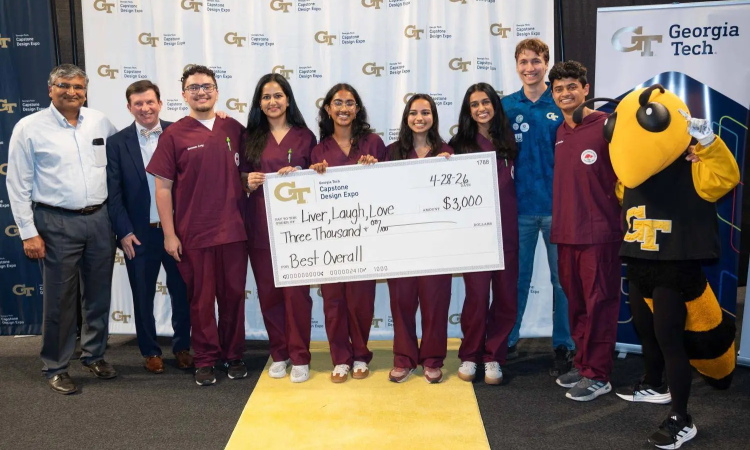
Protecting Organs, Water, and the Military Earn Top Honors at Capstone Expo
The spring 2026 showcase of senior design projects spanned engineering, design, computing, and liberal arts.
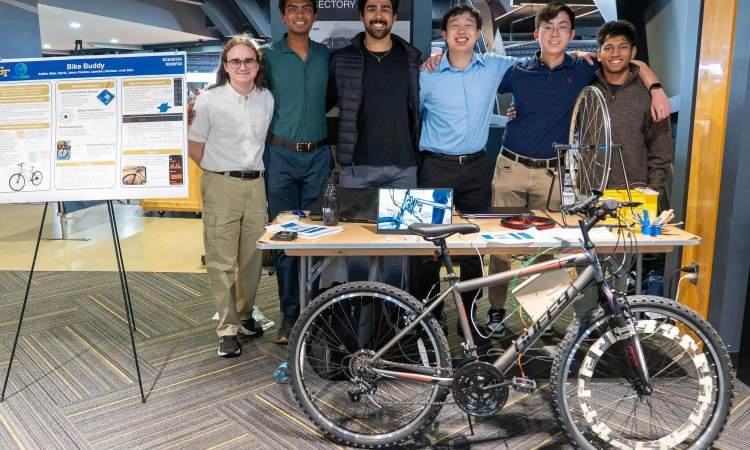
Bike Buddy Rolls to Victory as Top ECE Project at Fall Capstone Expo
The predictive cycling system headlined an Expo packed with ECE innovations across health tech, wearables, financial computing, smart home automation, and more.