
The predictive cycling system headlined an Expo packed with ECE innovations across health tech, wearables, financial computing, smart home automation, and more.
(text and background only visible when logged in)

Fall 2025 Capstone Design Expo Best ECE Project Winners: Bike Buddies.
(text and background only visible when logged in)
At Georgia Tech’s Fall 2025 Capstone Design Expo, the School of Electrical and Computer Engineering (ECE) made its mark with a mix of creativity, technical depth, and real-world impact.
Among the 118 projects on display from more than 620 students, the team that pedaled ahead of the pack and claimed the top ECE project was Bike Buddy.
Bike Buddy’s purpose is simple yet powerful. It helps cyclists avoid breakdowns before they happen.
“Amateur bike riders are typically unaware of how fast their components wear down,” said team member Harris Nesteruk. “We wanted to provide a solution for predictive bike maintenance while keeping the cost down as much as possible, especially given that we primarily sought to target college students with our product.”
The team’s solution uses an embedded hardware system to predict maintenance needs, ensuring riders aren’t stranded by unexpected failures. Cost-effective, easy to install, and fully on-device, Bike Buddy removes barriers that often keep technology out of reach.
The six-member computer engineering team includes Aniket Garg, Jason Hsiao, Nesteruk, Leandro Odorici, Keshav Parthasarathy, and Gate Tangchartsiri, and is advised by Professor Linda Milor.
The Bike Biddy system combines sensors for wheel rotation, temperature, humidity, and brake force with an ESP32-S3 microcontroller. Data is processed using classical machine learning and signal analysis, then sent via Bluetooth to a custom iOS app so cyclists receive actionable insights delivered straight to their phone.
“This project was an application of all the skills we have learned in the past few years at Tech, ranging from embedded systems to mathematical modeling,” Parthasarathy said. “All of us had previously taken ECE4180, and we found that the experience was invaluable throughout the development cycle. Most of us also had prior robotics experience that was valuable for sensor and system integration.”

A look at the embedded hardware solution, Bike Buddy.
The team now plans to train its model on real failure data and explore edge computing to improve accuracy and reduce noise, making the system even more reliable for everyday riders.

Team Running Soul developed a sensor embedded insole that collects pressure data exerted by the foot and provides the user with intuitive feedback.

Team HaloFit Engineers showcased their lightweight, sweat-resistant headband fitness tracker.

Team Paw Patrol created a system that integrates monitoring, play, and comfort into a single, convenient system for our feline friends.

The FPGA for Financial Data Processing team utilizes machine learning and custom hardware to quickly predict real estate ETF’s prices.
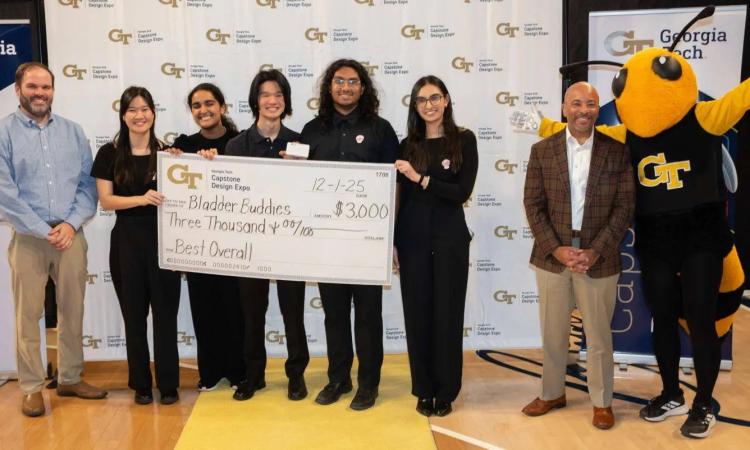
ECE students also played a significant role in the night’s biggest win: Bladder Buddies, which took home Overall Best Project.
The wearable device helps people with impaired nerve function know when their bladder is full—a challenge affecting 22 million Americans. By reducing risks like urinary tract infections and kidney damage, the project addresses a critical health need.
ECE contributors included Grace Nhan (EE), Rikhil Seshadri (CmpE), and Aric Ting (EE), and the project was advised by ECE Associate Professor Jeffer Davis.
Beyond the winners, ECE’s presence was everywhere with 11 dedicated ECE teams and nearly 25 projects with ECE students or faculty advisors. Highlights included:
- Running Soul, a sensor-embedded insole that helps runners prevent stress injuries.
- Cat Automated Smart Home combines remote monitoring, interactive play, and pet comfort into a single product.
- HaloFit, a premium wearable fitness tracker in the form of a lightweight, sweat-resistant headband
- FPGA for Financial Data Processing, which accelerates neural network predictions for housing-focused exchange-traded fund (ETF) price movements.
Other projects explored audio mixing, autonomous robots, and even analog-integrated computing, underscoring the breadth of ECE innovation.
(text and background only visible when logged in)
Related Content
Self-Assembled Eyeglasses, Wearable Device for Bladder Health Win Capstone Expo
The fall 2025 showcase included semester-long design projects from more than 600 students across engineering, design, and computing.
(text and background only visible when logged in)

Efficiency and Affordability Drive Groundbreaking ECE Projects at Spring 2025 Capstone Design Expo
The winning ECE project advances UAV technology using gallium nitride semiconductors, while the interdisciplinary winner creates affordable, precise reaction wheels for better satellite orientation control.
(text and background only visible when logged in)