
As a recognized expert in emerging semiconductor technologies and next‑generation computing technologies, the ECE Associate Professor will lead the IEEE Journal on Exploratory Solid-State Computational Devices and Circuits.
(text and background only visible when logged in)

(text and background only visible when logged in)
Georgia Tech School of Electrical and Computer Engineering (ECE) Associate Professor Asif Khan was named the editor-in-chief of the Institute of Electrical and Electronics Engineers (IEEE) Journal on Exploratory Solid-State Computational Devices and Circuits (JxCDC).
JxCDC is an IEEE Solid-State Circuits Society (SSCS) publication that focuses on exploratory devices and circuits for computation beyond standard complementary metal–oxide–semiconductor (CMOS) technology.
As the semiconductor industry confronts the limits of conventional scaling and the rapid growth of artificial intelligence workloads, new materials, device concepts, and circuit architectures are essential for achieving continued gains in energy efficiency and performance. JxCDC serves as a cross-disciplinary platform to advance these emerging technologies from materials to systems.
“My goal is to strengthen JxCDC as a first home for system-technology co-optimization, especially for emerging materials and device technologies and circuits, where ideas can connect end-to-end—from materials and physics all the way to circuits and computing systems—to enable the next generation of semiconductor technologies.”
Khan is a semiconductor technologist with global industry–academic reach, spanning logic, memory, and exploratory computing. His research advances next-generation semiconductor memory and computing technologies, with foundational contributions to ferroelectric field-effect transistors that shape modern logic, memory, and storage platforms.
Through the Khan Lab, he investigates all aspects of ferroelectricity and has made seminal contributions that enable new directions in low-power logic, AI hardware, and beyond-CMOS technologies.
On top of his ECE appointment, Khan also has a courtesy appointment in the School of Materials Science and Engineering.
Khan’s contributions have been recognized with the DARPA Young Faculty Award (2022), NSF CAREER Award (2021), Intel Rising Star (2020), Georgia Tech Outstanding Junior Faculty Award (2022), the CIOS Honor Roll Teaching Award (2020), participation in the GT Provost’s Emerging Leaders Program (2024), and selection to the EU–US Frontiers of Engineering symposium organized by the National Academy of Engineering and the European Council of Applied Sciences, Technologies and Engineering (2025).
Khan takes over the position from his Georga Tech colleague, ECE Professor Azad Naeemi.
“Under Azad’s visionary leadership, JxCDC has flourished as a premier venue for exploratory research in solid-state devices and circuits,” SSCS said in a release. “We thank him for his years of dedicated service and lasting impact on the SSCS and EDS communities.”
Read the journal here.
Related Content

Khan and Menon Selected for Prestigious EU-US Frontiers of Engineering Symposium
The National Academy of Engineering–affiliated symposium brings together top early-career researchers from both sides of the Atlantic to address critical challenges in science and technology.
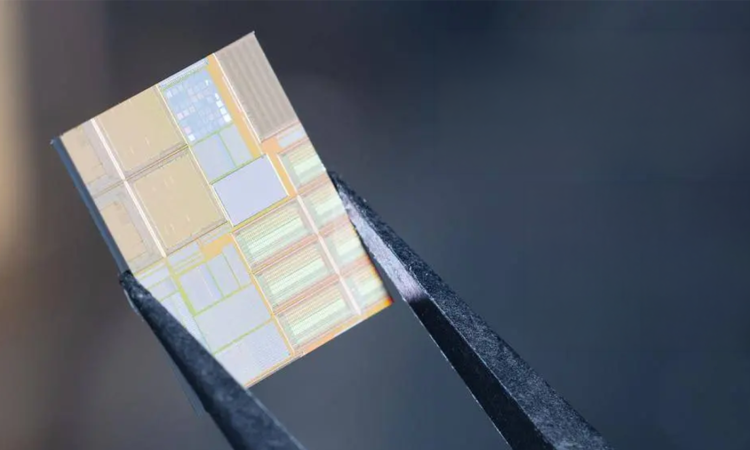
Smaller, Smarter, Speedier, Stacked: Engineering Next-Gen Computing
Some technologists suggest we’re nearing the limits of packing ever-more computing power into ever-smaller chips. At Georgia Tech, engineers are finding new ways to shrink transistors, make systems more efficient, and design better computers to power technologies not yet imagined.