
The GT-STAR program gives students opportunities to work with faculty mentors on research while exploring future internship and career opportunities with TSMC Arizona.

Members of the inaugural GT-STAR cohort will gain research experience, industry exposure, and mentorship through a collaboration between Georgia Tech and TSMC.
A collaboration between the Georgia Tech School of Electrical and Computer Engineering (ECE) and Taiwan Semiconductor Manufacturing Company (TSMC) is creating new opportunities for undergraduate students to participate in semiconductor research and engage with one of the industry's most influential companies.
Through the GT-STAR (Strategic Training & Advanced Research) Undergraduate Research Program, students will work closely with faculty and graduate student mentors while gaining industry exposure and exploring future internship and career opportunities with TSMC, the world's leading semiconductor foundry, as it expands its footprint in Arizona.
"As semiconductors become ever more central to powering the AI era, this collaboration with TSMC gives our students a unique opportunity to learn from and train for a crucial industry," said Matthieu Bloch, associate dean for Academic Affairs in the College of Engineering.
The collaboration addresses the continued need across the semiconductor industry for engineers with expertise in chip design, manufacturing, devices, and materials.
Students participating in GT-STAR will contribute to research projects under the guidance of faculty from ECE, the George W. Woodruff School of Mechanical Engineering, the School of Materials Science and Engineering, and the School of Chemical and Biomolecular Engineering. ECE mentors include Suman Datta, Asif Khan, and Shimeng Yu.

Leaders from Georgia Tech and TSMC met in September 2025 to discuss a new collaboration that would create undergraduate semiconductor research opportunities through the GT-STAR program.
"The semiconductor industry needs engineers who can contribute from day one," Yu said. "TSMC helps set the standard for much of the semiconductor industry, and GT-STAR gives students an early opportunity to develop the skills and experience needed to contribute in that environment."
The new program builds on Georgia Tech's broader efforts in semiconductor education and workforce development. Students already engage with industry leaders through research initiatives, industry-sponsored projects, and ECE's Course Partnership Initiative, which provides industry-informed coursework in areas such as chip design and tapeout, 3D heterogeneous integration, satellite communications, and more.
Those efforts extend beyond individual courses and research projects. Earlier this year, Georgia Tech was selected as Georgia's lead institution in the National Network for Microelectronics Education, a nationwide initiative focused on strengthening the U.S. semiconductor workforce and expanding pathways into microelectronics careers.
"The TSMC collaboration reflects our broader approach to engineering education, combining research, industry engagement, and workforce development," said Arijit Raychowdhury, ECE Steve W. School Chair. “Georgia Tech students are graduating with not only technical expertise, but also firsthand experience tackling complex problems with real-world impact.”
(text and background only visible when logged in)
Related Content
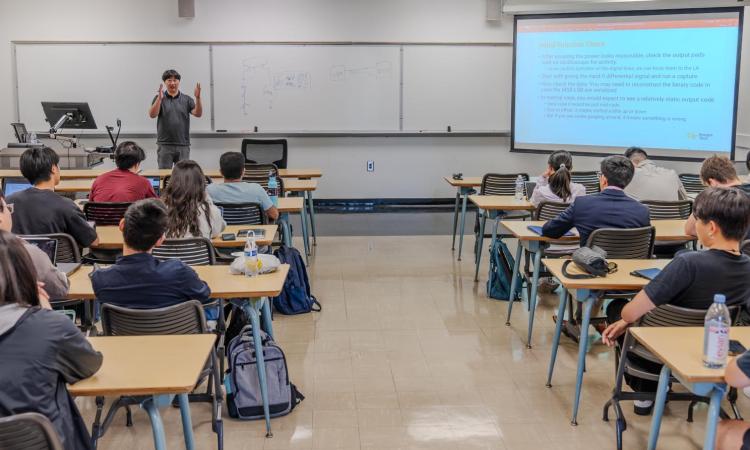
Curriculum Partnership Initiative Prepares Students for Evolving Tech Careers
The new initiative enhances industry collaboration within academic environments, bridging skill and workforce gaps in electrical and computer engineering.
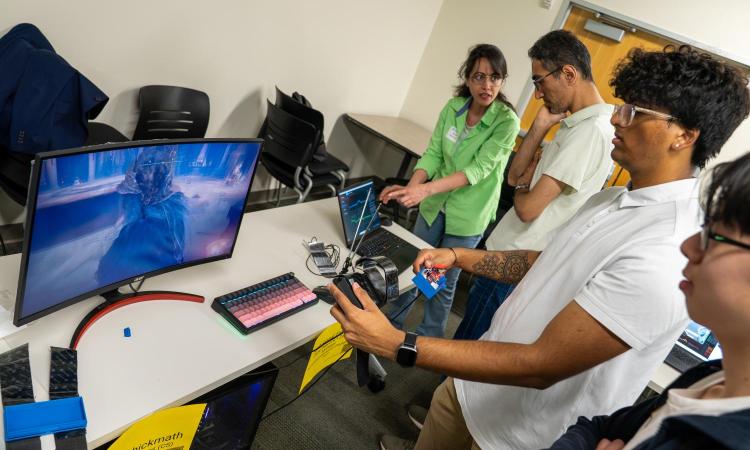
Innovate ECE Challenge Showcases Curriculum Threads in Action
Through the first-ever Innovate ECE: Ultimate Thread Challenge, students created and showcased projects designed to help peers and future students better understand the School's popular curriculum model.