
Through the first-ever Innovate ECE: Ultimate Thread Challenge, students created and showcased projects designed to help peers and future students better understand the School's popular curriculum model.

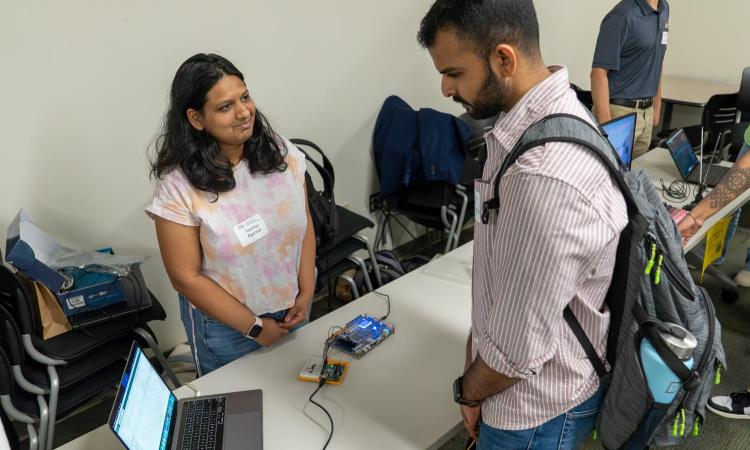
Aditya Chickmath demonstrates OmniBlade, a motion-based adaptive game controller designed for players with limb differences and winner of Best in Thread for Embedded Devices.
(text and background only visible when logged in)
In 2021, the School of Electrical and Computer Engineering (ECE) launched a thread-based curriculum that allows students to design their degrees around specialized areas of interest.
Based on student and faculty feedback, ECE Threads have been a success, but fully understanding technical fields of study and connecting them to real-world engineering practice can be challenging, particularly early in a student’s academic career.
To help address that challenge, the School launched the Innovate ECE: Ultimate Thread Challenge during the Spring 2026 semester, drawing 25 undergraduate project submissions that reflect a chosen ECE Thread.
“Innovate ECE was created to help demystify the threads, especially for newer and prospective ECE students,” said Lakshmi Raju, an academic professional in ECE who directs the School’s Office of Student Engagement and Well-Being and organized the event.
Designed with discovery in mind, the Ultimate Thread Challenge provided concrete project examples that help students better understand what different ECE Threads represent and how they connect to career paths. As part of their submissions, students were required to create two short videos explaining their chosen thread and demonstrating their completed projects (see the list of winners with video submissions at the end of the article).
(text and background only visible when logged in)
Innovate ECE: Ultimate Thread Challenge
Take a look inside ECE Innovate: Demo Day.

Students present and explain their projects during the inaugural Innovate ECE: Demo Day in the Klaus Building.

Team Piano demonstrates its digital piano project, earning Best in Thread for Signal and Information Processing.

Dibeline Wa’aloun presents a computer vision project focused on real-time waste classification, earning an Honorable Mention in Information Internetworks.
On April 17, those projects were presented at the Innovate ECE: Demo Day, an in-person showcase held in the Klaus Advanced Computing Building. During the hour-long event, students demonstrated their work and spoke directly with attendees about their ideas, design decisions, and technical challenges.
Among the standout projects on display was one by Andrew Lemons, a fourth-year student who earned both the Grand Prize and a Best in Thread Award for Information Internetworks. His project combined radio systems and mesh networking into a working system that illustrated how information moves, connects, and is used across networks.
“I wanted to build something self-directed that clearly represents what I’ve learned, rather than just completing an assignment,” Lemons said. “The idea of taking an abstract thread like Information Internetworks and turning it into a concrete, working system was especially appealing.”
Lemons, who will graduate this semester, also noted that projects like his help clarify how threads function beyond individual courses.
“It’s easy to think of threads in terms of classes rather than a cohesive way of thinking about an engineering field,” he said. “Projects like this show how the concepts actually come together in practice.”

Lemons poses with his Grand Prize and Best in Thread awards alongside Raju, who organized the Innovate ECE: Ultimate Challenge.

Becker holds her People’s Choice Award with Raju at the Innovate ECE: Demo Day.
Also on display at the Demo Day was an embedded alarm system for houseplants, created by Kayla Becker, a first‑year electrical engineering student and winner of the People’s Choice Award. Her system uses soil moisture sensing and external plant data to determine when a plant needs water, applying calibration and averaging techniques to reduce sensor noise.
“I think sometimes the title of a thread can be overwhelming because there are so many realms of ECE,” Becker said. “Being able to focus that definition on a specific topic or industry is really helpful to understanding the threads. As a student, I find the threads incredibly helpful for shaping my curriculum and my career planning.”
Other projects demonstrated the diversity of the threads, from digital signal processing through a fully functional electronic piano, to a systems architecture project that broke complex processors and compilers into accessible, working components.
Winning projects will be featured across ECE communication channels and shared with prospective and new ECE students as they explore academic paths within the School.
“This wasn’t just a competition,” Raju said. “It was a learning space, a mentoring space, and a way for students to see themselves reflected in the curriculum. That’s exactly what we hoped Innovate ECE would become.”
(text and background only visible when logged in)
Innovate ECE: Ultimate Thread Challenge Winners
Grand Prize + Best in Thread
Sensor Net
Thread: Information Internetworks
Andrew Lemons
Best Documentaion Award
METEOR Satellite Downlink
Thread: Telecommunications
Zach Evans, Will Sasadu
People's Choice Award
Plant Watering Alarm System
Thread: Signal & Information Processing
Kayla Becker
Best in Thread
sEMG Detection Board
Thread: Bioengineering
Michael Rascher
Best in Thread
Whack-a-Switch
Thread: Computing Hardware and Emerging Architectures
Jaivardhan Jain
Best in Thread
Arduino USB Rubber Ducky
Thread: Cybersecurity
Alex Sareh
Best in Thread
Faraday Earth Motor
Thread: Electric Energy Systems
Keven Diaz
Best in Thread
OmniBlade
Thread: Embedded Devices (CS)
Aditya Chickmath
Best in Thread
A.R.I.S. (Autonomous Rescue & Inspection System)
Thread: Robotics and Autonomous Systems
Saksham Bansal
Best in Thread
Wearable Free Fall Detection System
Thread: Sensing & Exploration
Matthew Cargill
Best in Thread
Piano
Thread: Signal & Information Processing
Kyle de Nobel, Marco Yaipen, Pranjal Chatterjee
Best in Thread
SAM Language and Processor
Thread: Systems & Architecture (CS)
Sam Hauck
Best in Thread
SDR Signal Explorer
Thread: Telecommunications
Zane Peacock, Zahra Mohseni
Honorable Mention
Kayla Becker
Thread: Telecommunications
Dibeline Wa'aloun
Thread: Information Internetworks
Luke Wu
Thread: Information Internetworks
Eugene Li
Thread: Sensing & Exploration
(text and background only visible when logged in)
Related Content
(text and background only visible when logged in)
Student Engagement and Well-Being
Promoting habits of academic excellence, essential life skills, and mental health.
(text and background only visible when logged in)