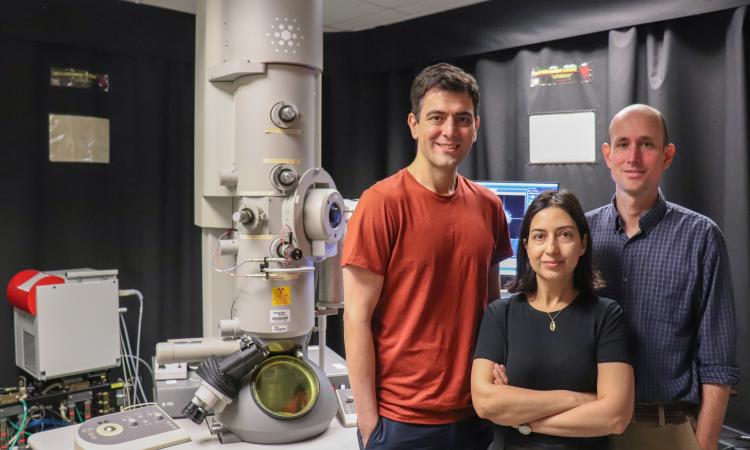
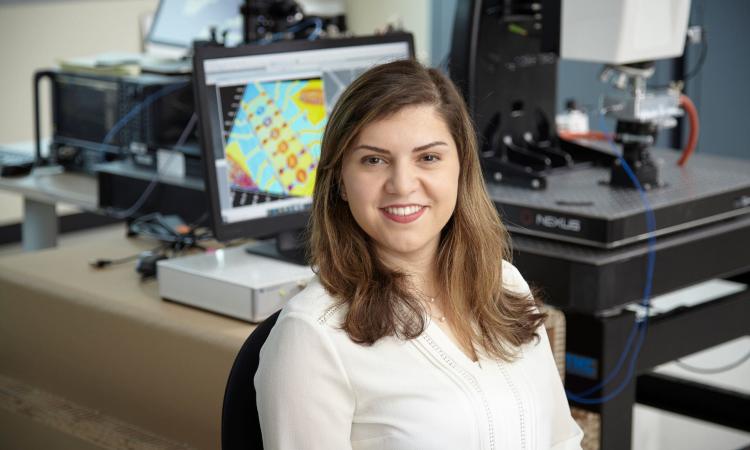
Christopher Rozell to lead Georgia Tech’s new Institute for Neuroscience, Neurotechnology, and Society, uniting disciplines to tackle the brain’s greatest challenges.
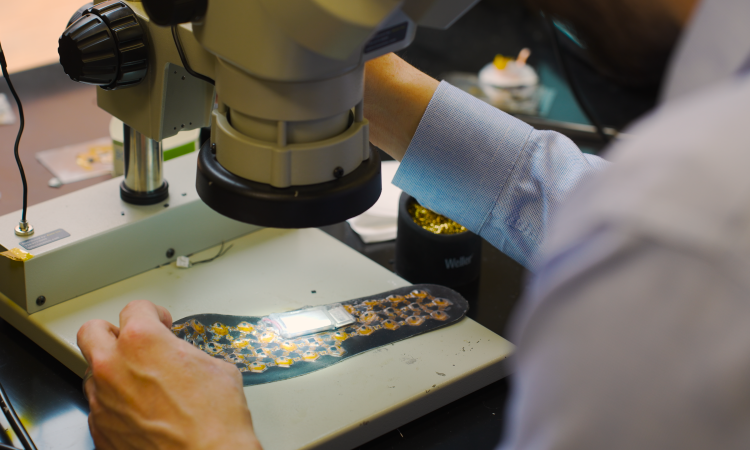
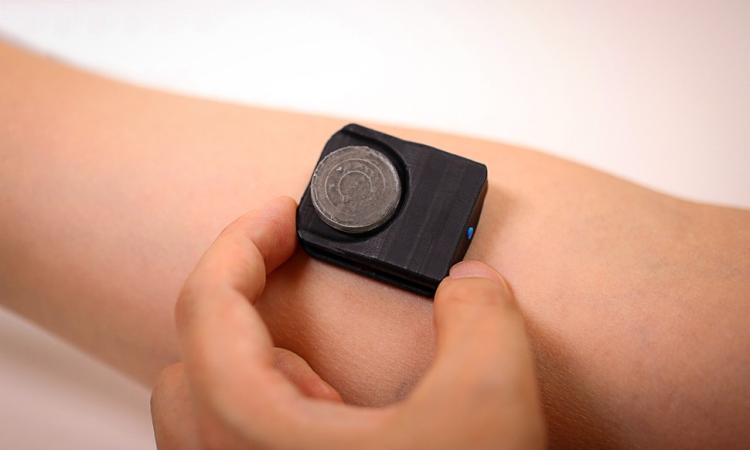
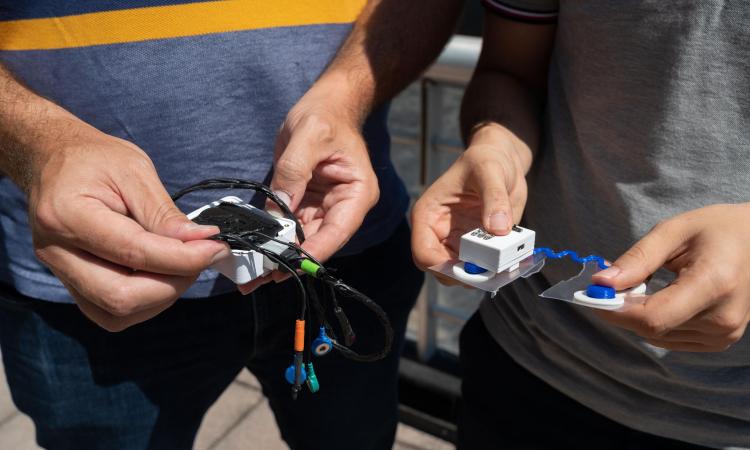
The device is the first of its kind to continuously monitor how the skin exchanges gases with the environment, helping to monitor skin health and wound healing.
Funding for the Georgia Tech and Emory University training program in computational neural engineering was recently renewed and increased by the National Institutes of Health, expanding opportunities for students and scholars.
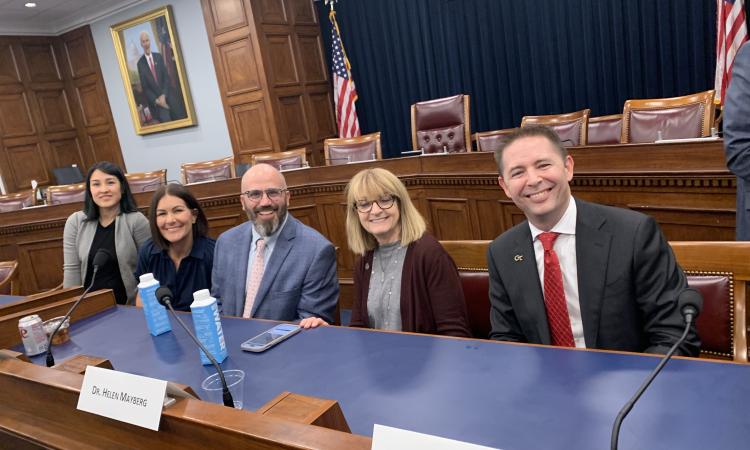
Chris Rozell traveled to Washington, D.C. to share the impacts of the past decade of brain research funded by the NIH BRAIN Initiative with Congress — and share with local representatives how Georgia Tech is playing a key role in leading the charge.
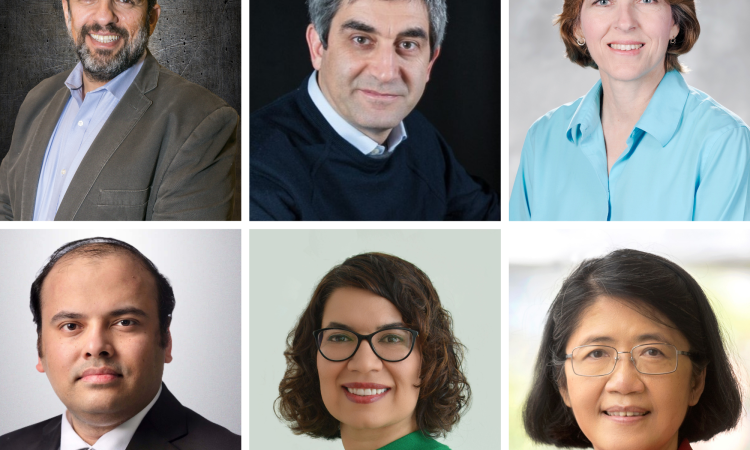
Six Georgia Tech faculty members were named IEEE Fellows, effective January 1, 2022. They are Ghassan AlRegib, Levent Degertekin, Bonnie Ferri, Arijit Raychowdhury, Maryam Saeedifard, and May Dongmei Wang.
Research conducted by an Emory University-Georgia Tech team supported the Breakthrough Designation from the U.S. FDA of the gammaCoreTM nVNS device for the treatment of post-traumatic stress disorder.
ECE Ph.D. student Mohammad Sendi received the J. Norman and Rosalyn Wells Fellowship Award, which is presented by the Wallace H. Coulter Department of Biomedical Engineering at Georgia Tech and Emory University.

A study from researchers at Georgia Tech and Georgia State University finds that Covid-19 patients experience a higher level of disability caused by lower gray matter volume in the front region of the brain.
Georgia Tech ECE Assistant Professor Shaolan Li is part of an effort to develop a wearable device for patients with pneumonia, allowing medical personnel to track their progress remotely and use data to predict how their condition may change.
Ten recently minted Georgia Tech ECE Ph.D. graduates and postdoctoral fellows/associates have been hired into faculty positions around the world, despite a difficult and challenging job market.
ECE Ph.D. student Alex Fedorov received the best student paper award at the IEEE International Conference on Health Informatics, which was held August 9-12 in a virtual format.
ECE Ph.D. student Asim Gazi received a third-place prize Best Paper Award at the IEEE-EMBS Biomedical and Health Informatics Conference, held July 27-30 in a virtual format.
ECE Associate Professor Hua Wang has been appointed as a Distinguished Microwave Lecturer for the IEEE Microwave Theory and Techniques Society (MTT-S) for the period of 2022-2024.
Ying Zhang has been appointed as the senior associate chair for the Georgia Tech School of Electrical and Computer Engineering (ECE), effective August 1, 2021.
Three students in the Georgia Tech School of Electrical and Computer Engineering (ECE) have received funding through the National Science Foundation (NSF) Graduate Research Fellowship Program (GRFP).
Georgia Tech engineering alumni Jaime Zahorian and Sarp Satir – both with Ph.D.s in electrical and computer engineering –are helping Butterfly Network to advance their goal of making healthcare more accessible for all.
ECE Associate Professor Hua Wang has been selected for the 2021 Qualcomm Faculty Award (QFA) for his contributions to Next-Generation (5G Beyond and 6G) Wireless Circuits, Systems, and Infrastructures.
Six faculty members from the Georgia Tech School of Electrical and Computer Engineering (ECE) have been awarded promotion and/or tenure, effective August 15, 2021.
ECE Associate Professor Omer Inan has worked with colleagues from UCSF and Northwestern to design a wearable device that adults with preexisting conditions can use to monitor their heart and lung function from the comfort of their own homes.
ECE Ph.D. student Ahmad Rezvanitabar has been named as a recipient of the 2020-2021 IEEE Solid-State Circuits Society (SSCS) Predoctoral Achievement Award.
The Capstone Design Expo returned to McCamish Pavilion for the first time since the fall of 2019, with more than 500 students broken into 118 teams from seven schools and three colleges participating.
ECE Ph.D. students Aline Eid and Asim Gazi recently participated in workshops geared toward developing and diversifying the next generation of academic leaders.
The Center for Signal and Information Processing hosts seminars on Fridays at 3 pm, continuing a tradition of extended learning that has lasted for more than two decades.
The National Science Foundation (NSF) has issued a renewal grant of 7.5 million dollars for a five-year period (2020-2025) to continue support of the Southeastern Nanotechnology Infrastructure Corridor (SENIC) as one of 16 sites within the NNCI.