
Run by HKN, an honor society for electrical and computer engineering students, the program delivers affordable, dependable lab kits and demonstrates how a student‑run effort can grow into a lasting success.
(text and background only visible when logged in)

(text and background only visible when logged in)
Dean Sprinkle remembers coming to Georgia Tech, where, along with adjusting to college life, he faced the first of many challenges in studying electrical engineering.
A number of foundational classes in the School of Electrical and Computer Engineering (ECE) curriculum have lab components that require supplies beyond the typical textbook and notebook paper.
These include transistors, breadboards, and many other things that can’t be found at the bookstore.
“As someone who didn’t do a lot of personal projects in high school, I didn’t know all the tricks of the trade, so diving headfirst into this engineering program was a little difficult,” Sprinkle said. “Once you’re in class, you look at the syllabus, and you have all these questions like ‘How big does my breadboard need to be? How many of these wires do I need?’”
That’s where the Eta Kappa Nu (HKN) Lab Supplies Sale has been helping students for 20 years.
Starting in 2005, Georgia Tech’s Beta Mu Chapter or HKN— the IEEE honor society for electrical and computer engineering students — has bought lab supplies and assembled complete kits for some of ECE’s most popular classes to sell to students at a discounted rate.
During add/drop week, they set up a table on the third floor of the Van Leer building where students from ECE and other engineering schools can get almost everything they need for ECE-taught labs.
“We have older students in HKN who have been through the classes and can tell the younger students what they’ll actually need,” Sprinkle said, who is now a first-year ECE master’s student and HKN president.
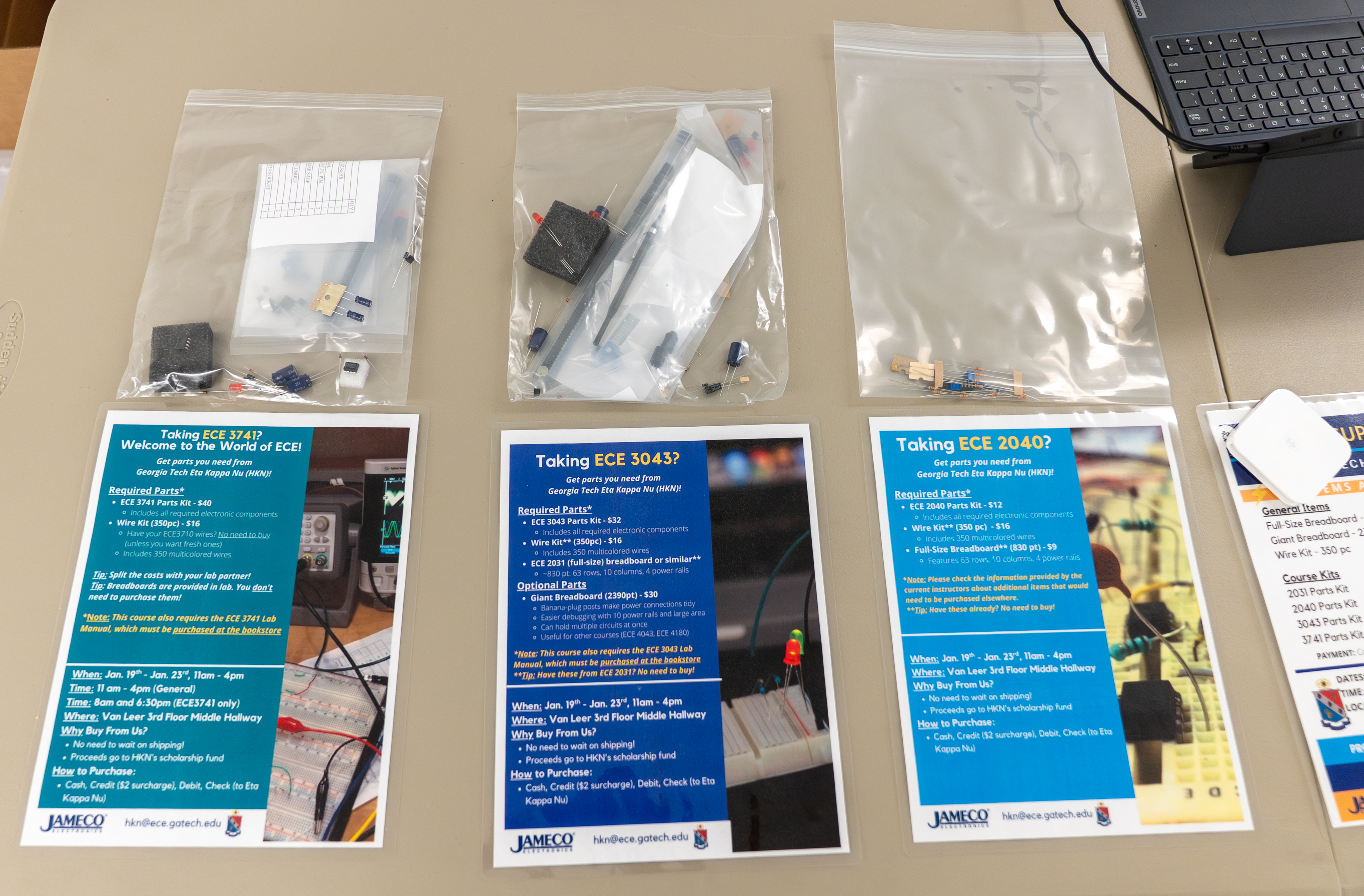
HKN offers complete lab kits for several courses, including ECE 3741, ECE 3043, and ECE 2040.
What first started as a service project for a trio of HKN students, Tom Hanley (M.S. ECE 2005, Ph.D. ECE 2008), Ryan Westafer (M.S. ECE 2006, Ph.D. ECE 2009), and Matt Wiggins M.S. ECE 2006), the program initially faced some questions from lab faculty about whether an organization with frequent turnover could sustain and scale.
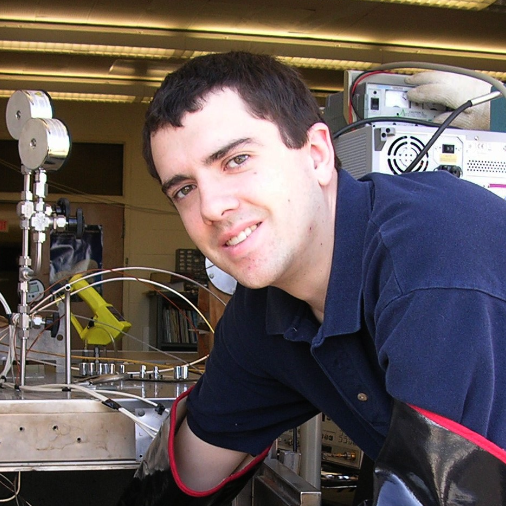
Tom Hanley (M.S. ECE 2005, Ph.D. ECE 2008), who was a graduate student in 2004, had the idea to start the Lab Kits Program as a way to serve students and ease the stress of maintaining the supplies needed for the growing ECE undergraduate lab program.
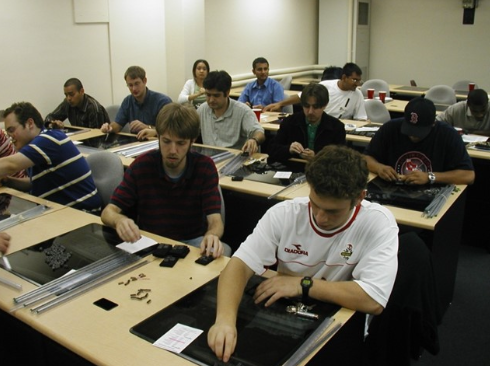
One of the first HKN packing parties, where students assemble the kits for sale. It's a tradition that still remains today and has become a part of the HKN initiation process.
With careful planning and the help of staff and faculty like faculty advisor Regents Professor Thomas Gaylord and senior academic professional Robert Robinson, it’s become one of the club’s most successful programs, described as a “proverbial finely tuned Swiss watch” by faculty leadership.
“The early negative feedback on the idea for the program was disappointing for the students, but they remained undaunted,” Gaylord said. “They took the feedback and created a more comprehensive proposal, which prompted faculty to give them an opportunity to try it out for one semester. And here we are 20 years later.”
Towards the end of every semester, the incoming HKN class comes together with the club leaders for a “packing party.” Over three hours, they take up to 10,000 parts and assemble the kits for the following semester’s sale.
The parts come from reputable dealers, which is important, according to Sprinkle, who has seen classmates’ projects not work because of faulty parts.
“Students are always looking to save money, so sometimes they turn to cheap online sellers,” Sprinkle said. “These prototypes in class are kind of the final litmus test for whether your idea works. And it’s not fun when you see someone do everything right in class and then their project doesn’t work because parts are defective.”
All of the money from the sale goes back into the club’s fund, which gets used to support the following semester’s sale, as well as the scholarships that HKN awards each year.
According to Gaylord, the program was the key contributor to HKN establishing an endowment in 2008, which has grown to over $80,000 and remains one of the few self-sufficient endowments among HKN chapters nationally.
HKN recently celebrated the 20th anniversary of the program with the Georgia Tech Foundation.
“The growth of the program has been remarkable,” Gaylord said. “We’re very proud of the impact it’s had on students, not only in the lab but also with the scholarships we’ve been able to award.”
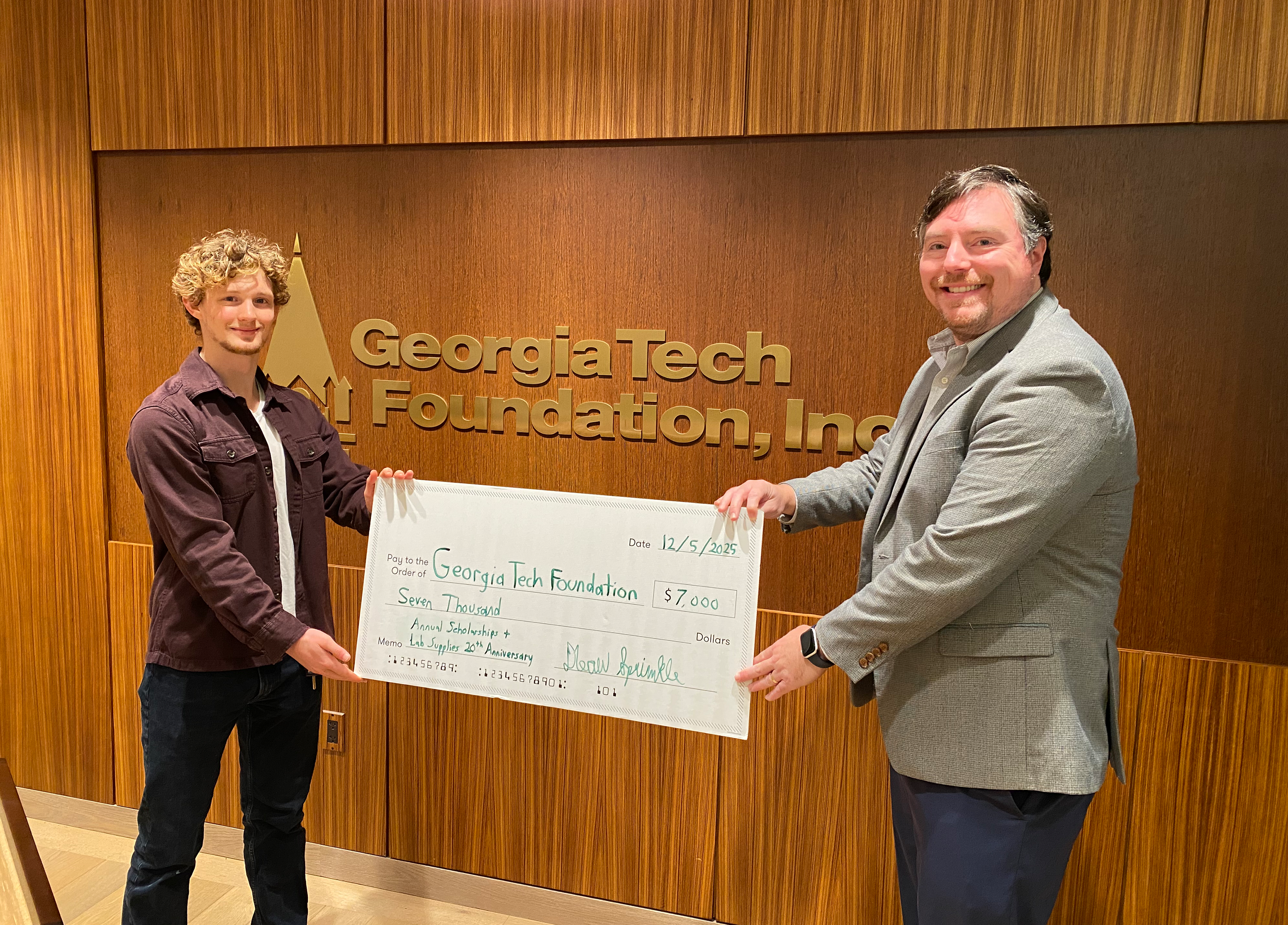
HKN president Dean Sprinkle presents a large contribution to the GT Foundation in celebration of 20 years of the Lab Supplies Program.
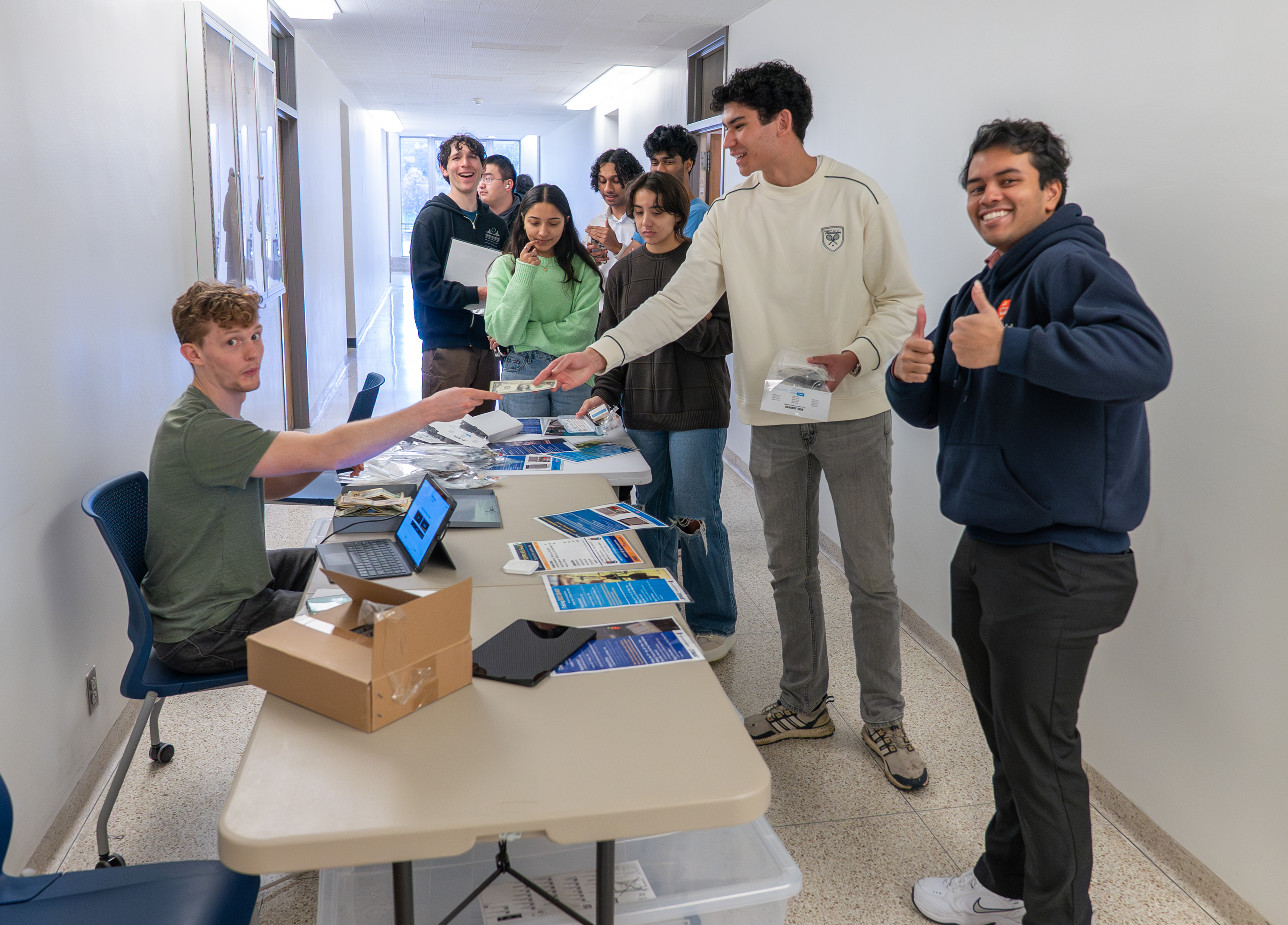
Hundreds of students buy supplies from HKN every semester.
This year, HKN sold full kits for four labs: ECE 2031, ECE 2040, ECE 3043, ECE 3741. That’s an increase from three last semester, while also offering individual parts students might need for other classes.
The goal is to keep expanding the program so that at some point, students can come to HKN Lab Sale not just for class supplies but also parts for personal projects.
“We want to empower students to turn whatever idea they have into reality,” Sprinkle said. “If a student has an idea and they need a microcontroller, we don’t want them to overpay or have to wait for it.”
As students line up to get supplies for this semester and beyond, some for their very first lab, they’ll walk away set up for success as they embark on their ECE journey.
“At the end of the day, engineering is about making something that improves people’s lives,” Sprinkle said. “We feel like we’re doing that with this program. I know the Lab Supplies program helped me as a young ECE student, and we’re hoping it continues to do that for others going forward.”
Learn more about HKN and the Lab Supplies Program here.
(text and background only visible when logged in)
Related Content
Apple Vision Pro Powers New Wave of Immersive Education
Spatial computing is transforming engineering education at Georgia Tech and opening new paths for entrepreneurship and technical training.
Gaylord Wins IEEE-HKN Distinguished Service Award
Honored for decades of service, the Regents Professor has been instrumental in supporting Beta Mu, Georgia Tech’s Eta Kappa Nu chapter, widely regarded as one of the strongest in the country.