
Created to meet the needs of projects where electrical and mechanical performance are tightly coupled, the resource gives ECE students and researchers the tools and guidance needed to navigate challenges with confidence.

Brandon Royal, manager of the ECE mechanical shop, stands in the shop where he guides students and researchers through designing, prototyping, and building the mechanical systems that support complex electrical engineering projects.
(text and background only visible when logged in)
Electrical and computer engineering projects take many forms. No matter where they begin, most eventually reach a point where the work depends on mechanical decisions.
Maybe a circuit board needs a custom enclosure for safety, a sensor requires a precision-machined metal fixture, a prototype demands better cooling, or a test setup needs a welded structure that can survive repeated use.
These practical considerations play a major role in whether a project moves forward or stalls.
The new mechanical shop in the School of Electrical and Computer Engineering (ECE) was built for exactly these types of moments.
“It is a space where projects across ECE can develop the structural, mechanical, and material foundations they need to become reliable in real‑world use,” said Brandon Royal, who manages the mechanical shop.
A Need That Kept Resurfacing
The shop grew from years of informal problem‑solving. Before it ever took shape as a dedicated resource, Royal had already become the person students and researchers sought out whenever a project required a mechanical solution beyond what a typical makerspace or lab could offer.
Royal began his career at Georgia Tech in 2013 in the former Prototyping Machine Shop in the George W. Woodruff School of Mechanical Engineering, contributing to the development of the Montgomery Machining Mall.

With guidance from Brandon Royal, Ph.D. student Piyush Chauhan learns to operate a CNC machine while prototyping precision components for high‑efficiency electric machine research.

Master's student Hannah Xiao practices welding techniques in the ECE mechanical shop as she builds safe, high‑voltage enclosure components for her research.

Undergrad Peter Chen tests a component on an electric bike as he learns the mechanical skills needed to build his own.
He joined ECE in 2016 and spent much of his career in Professor Emeritus Deepak Divan’s Center for Distributed Energy (CDE), where high‑power prototypes and complex electrical hardware presented everyday design challenges. From mounting to connections, cooling, and isolation, mechanical needs were consistently addressed.
When CDE activities shifted after Divan retired from Georgia Tech in 2025, the steady stream of mechanical questions did not disappear. The demand underscored the need for a space that blended mechanical skill with electrical understanding.
“This space has a clear purpose,” Royal said. “It exists to support projects wherever mechanical decisions matter. This means providing design-integrated mechanical support, from straightforward questions to more complex systems involving higher levels of risk or electrical interaction.”
That support is collaborative and iterative. Royal works with users early, sketching and brainstorming to define what an often “unknown mechanical part” needs to do. Concepts then may move through computer-aided design (CAD) iterations, 3D‑printed prototypes, and into durable builds ready for repeated lab testing or real‑world use.
“People usually have the electrical side worked out, but the mechanical piece is less clear,” Royal said. “The goal is to help turn an early idea into something functional and safe, and into a result the student can be proud of.”
Supporting ECE’s Culture of Hands‑On Engineering
ECE is one of the largest and most deeply specialized programs in the country, with research and instruction spanning semiconductors and circuits, power electronics and systems, bioengineering, computer architecture, robotics, sensing, and more.
Across this breadth, research groups frequently need custom mechanical solutions that directly affect electrical performance and safety.
Ph.D. student Piyush Chauhan, a member of Professor Baoyun Ge’s Electric Machines Lab, has used the shop to fine tune his CAD designs, refine mechanical solutions, and develop prototypes that advance the lab’s research on high‑efficiency electric powertrain systems. His work integrates electric machines, power electronics, and advanced control strategies—efforts that depend on custom parts, precise assemblies, and rapid prototyping.
Chauhan says the ECE mechanical shop offers far more than fabrication. Unlike a traditional machine shop where students simply submit designs, it functions as a collaborative, hands‑on environment where designs improve through guided iteration.
“Brandon keeps a constant feedback loop with me and helps co‐design mechanical solutions around real constraints like fits, tolerances, materials, and assembly,” Chauhan said. “The shop’s specialized tools, plus one‑on‑one guidance, made iteration fast and educational. It has helped me grow real confidence as a more well‑rounded Georgia Tech engineer.”
What the ECE Mechanical Shop Provides
One-on-One Consultation
- One-on-One Consultation
- Whiteboarding sessions for early identification of mechanical obstacles/approaches
- Project mechanical design trajectory considerations
- DFM (Design For Manufacture)
- Repair route recommendations
- Design iteration support from concept through fully-functional prototype
- Help transitioning early “box around the circuit” concepts into achievable integrated assemblies
Mechanical-Focused Repair, Servicing, Diagnosis
- Broken hardware (welding, machining or replicating/improving)
- Lab equipment mechanical fixes or diagnosis
- Personal transportation projects or repair needs (bicycles, scooters, electric conversion, etc.)
CAD/CAM Support
- CAD modeling guidance for users, or for planning projects’ physical layout
- CAM programming for custom machines parts
Fabrication and Prototyping
- Conventional and CNC machining (mill/lathe) for metals and most plastics
- Sheet‑metal cutting and forming
- TIG welding
- Large-format assembly fixturing via precision ground table
- Laser cutting and fine metal engraving
- Array of metal-oriented tools: sanders, saws, shears, polishers, etc
- 3D printing up to 350x350x350 mm
- Full suite of precision metrology equipment supporting fit, alignment, and validation
Training and Access
- Guided tool training modules offered for groups on appropriate equipment
- Project‑based access for students across ECE, research teams, and senior design groups
Testing that Supports Mechanical Decisions
- Hi‑pot testing for dimensional clearance validation
- Thermal and humidity testing of designed projects
- LCR measurements for adjusting dimensions/turns/air gaps on custom magnetics work
A Strategic Part of ECE’s Learning Ecosystem
The shop also strengthens instruction and experimentation. It complements hands‑on coursework, advanced projects, and independent exploration by helping students apply mechanical thinking to electrical goals.
It sits alongside key ECE student resources dedicated to making and applied experimentation, including:
-
The Interdisciplinary Design Commons, widely known as The Hive: Georgia Tech’s largest student‑run makerspace and one of the premier electronics‑focused makerspaces in the country.
-
The Robotarium: a remotely accessible swarm‑robotics facility that allows anyone in the world to run experiments on real robotic hardware.
-
The AI Makerspace: a first‑of‑its‑kind supercomputing cluster where students can develop AI skills using powerful resources typically reserved for research labs.
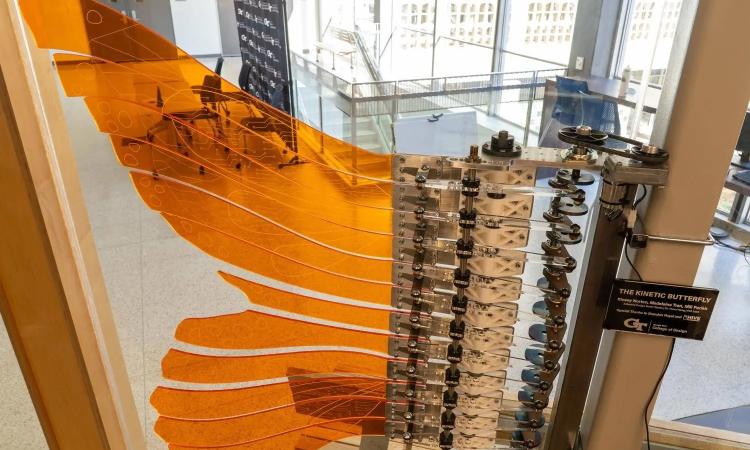
A visible example of this “making” culture is the Kinetic Butterfly installation in the Hive. Created by three industrial design seniors and inspired by real butterfly motion, it uses sensing and actuation to “flutter” in response to visitors.
The students consulted Royal on manufacturable linkage geometry, machining aluminum backing plates and hardware, and assisting with assembly and installation to ensure reliable motion and safe operation in a public space.
(text and background only visible when logged in)

Students (L- R), Milli Parikh, Kinsey Norton, and Madeline Tran with the Kinetic Butterfly in the Hive. The students utilized ECE mechanical resources and tools to make build the art installation.
The mechanical shop’s resources have also opened the door for students to experiment beyond coursework, applying mechanical skills to their own ideas and personal projects.
Peter Chen, a third‑year computer engineering student, has been using the shop to disassemble, study, and rebuild bicycle components as he works toward designing his own electric bike.
Hannah Xiao, a first‑year master’s student researching under Professor Lukas Graber, has been learning to weld in the shop as part of a high‑voltage power systems project, gaining the practical fabrication skills needed to build safe, structurally sound enclosures.
The Next Phase
Royal expects the shop to grow as more students discover what they can achieve with it. In the coming months, he anticipates adding focused training modules covering topics such as mechanical fundamentals, material selection, CAD design, machining and welding, and mechanical integration techniques that support safe, reliable electrical hardware.
As demand increases, student assistants may also be hired to support day‑to‑day activities, training sessions, and peer mentoring under staff supervision.
“Students already play a meaningful role in shaping the shop’s evolution,” Royal said. “Their projects continuously refine how the space operates.”
Beyond fabrication or technical troubleshooting, Royal believes the shop’s deeper value lies in helping students and researchers develop practical engineering judgment.
“The more people use the shop, the more they realize mechanical design isn’t a barrier,” Royal said. “It’s a tool that expands what their ECE work can become.”
That shift in perspective often becomes real in hands‑on moments of discovery in the shop.
“I’ve seen the look on people’s faces when they have that ‘A‑HA!’ moment, and they realize they’re capable of tackling hardware challenges they once thought were out of their realm,” Royal said. “The confidence they leave with—both personally and as better engineers—is tremendous.”
Working on something that might benefit from the ECE mechanical shop? Email Brandon Royal at broyal@gatech.edu.
(text and background only visible when logged in)
Related Content
The Kinetic Butterfly: A Gift to the HIVE Community
Three Georgia Tech industrial design students transformed their Senior Capstone project into a lasting gift for the Hive Makerspace.
(text and background only visible when logged in)

Engineering the Car of the Future
ECE experts look to the future of the automotive industry, and how new technology will not only transform vehicles, but reshape the power grid, influence policy decisions, and impact numerous aspects of society.
(text and background only visible when logged in)