
The meeting showcased AI innovations transforming seismic interpretation, processing, and imaging to deliver faster, more reliable subsurface insights for energy and environmental applications.

Professor Ghassan AlRegib at the Center for Machine Learning for Seismic's annual partners meeting. The center explores AI and physics-based methods to speed up seismic interpretation and make energy exploration more efficient and sustainable.
(text and background only visible when logged in)
Georgia Tech’s Center for Machine Learning for Seismic (ML4Seismic) hosted its annual partners meeting at the end of November, bringing together researchers and industry leaders to explore how artificial intelligence (AI) is reshaping seismic processing, interpretation, and analysis.
ML4Seismic focuses on developing intelligence systems that combine machine learning and physics-based methods to interpret complex seismic data.
These systems help accelerate subsurface imaging, improve reservoir characterization, and reduce the environmental footprint of exploration and monitoring, capabilities essential for energy companies navigating complex geophysical challenges.
“Machine learning gives us the ability to see patterns in seismic data that were previously hidden,” said ML4Seismic co-director Ghassan AlRegib, who runs the Omni Lab for Intelligent Visual Engineering and Science (OLIVES) in the School of Electrical and Computer Engineering (ECE). “We are creating intelligent frameworks that learn, adapt, and provide insights that empower both scientists and industry partners.”
AlRegib leads ML4Seismic with Georgia Research Alliance Eminent Scholar Felix J. Herrmann, who has appointments in the Schools of Earth and Atmospheric Sciences, Computational Science and Engineering, and ECE.

Ph.D. students Mohammad Alotaibi and Prithwijit Chowdhury.

Ph.D. student Chen Zhou.

Ph.D. student Jorge Quesada presenting.

Ph.D. students Abdelrahman Musleh, William Stevens, and Sahil Mithani.

Postdoctoral fellow Mohair Prabhushankar and Ph.D. student Seulgi Kim.
Exploring New Frontiers
The meeting featured sessions on how AI can tackle real-world challenges in seismic interpretation. Speakers discussed ways to make large-scale models more adaptable to seismic data and strategies for improving reliability when applying models across different geological settings.
Other talks explored how to preserve critical information during training and how to better handle uncertainty, issues that directly impact the accuracy of subsurface imaging.
“The field is changing rapidly,” said AlRegib. “AI is no longer just an add-on. It is becoming central to how we understand and interact with subsurface data. Our goal is to ensure these technologies are robust, trustworthy, and aligned with industry needs.”
Additionally, interactive tutorials gave participants practical insights into applying these ideas.
“The interest in some of the new directions our students have been exploring was great, and we already have a few follow ups to expand on these directions.” AlRegib said.
For example, one tutorial compared two popular AI approaches, Convolutional Neural Networks (CNNs) and Transformers, to show how they process seismic images differently, highlighting the possible directions in deploying transformers for such applications.
Others focused on techniques for guiding large models without retraining and methods for evaluating how well models learn from limited data.
A Human-Centric Future
AlRegib’s closing overview talk emphasized a shift from data-centric to human-centric AI, advocating for systems that prioritize transparency, robustness, intuition, and trustworthiness.
He said this priority shapes ML4Seismic’s goal to create intelligence systems that balance cutting-edge technology with reliability and ethical responsibility.
More details can be found here: https://alregib.ece.gatech.edu/ml4seismic/ml4seismic-2025/ and https://slim.gatech.edu/content/ml4seismic-partners-meeting-2025
(text and background only visible when logged in)
Related Content
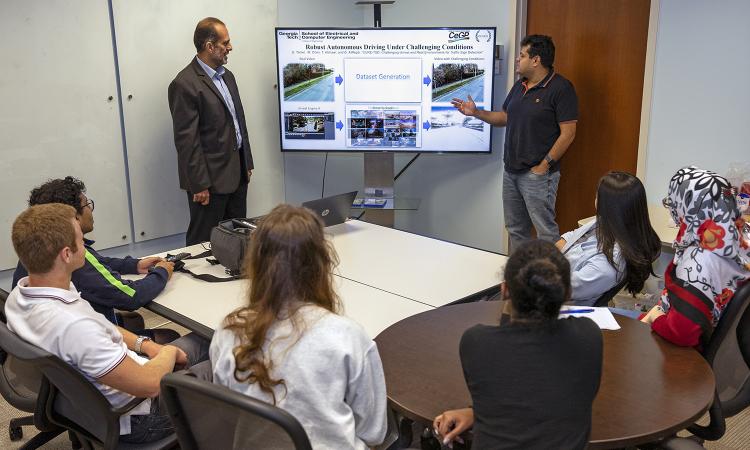
ECE Research Group & Lab Spotlight: OLIVES
Ghassan AlRegib's Omni Lab for Intelligent Visual Engineering and Science (OLIVES) is is at the forefront of today’s computer vision and visual machine learning research.
(text and background only visible when logged in)
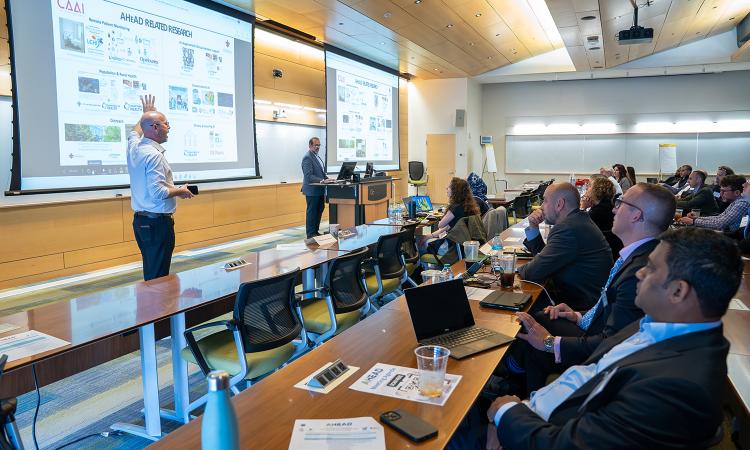
Georgia Tech Brings Industry and Academia Together to Plot the Future of AI in Healthcare
The Accessible Healthcare through AI-Augmented Decisions (AHeAD) Center’s planning meeting charted a path to enhance patient experiences and outcomes through AI innovation.
(text and background only visible when logged in)