
Researchers at the Georgia Tech-led Joint University Microelectronics Program 2.0 center, focused on creating smarter, energy-efficient cognitive sensors, shared the progress they’ve made as it passed the halfway point of its five-year timeline.
(text and background only visible when logged in)

(text and background only visible when logged in)
As the Center on Cognitive Multispectral Sensors (CogniSense) passed the halfway point of its five-year timeline, it held its third annual review, looking at the progress its researchers have made to create smarter, energy-efficient cognitive sensors, while also looking ahead at what’s still left to accomplish.
Over 115 students and 20 principal investigators from 11 universities across the country gathered at the Georgia Tech Global Learning Center to share their research and receive feedback from industry partners, including Intel, IBM, and Samsung.
“This year’s accomplishments reflect the dedication, creativity, and collaboration of our entire team,” CogniSense Director and Georgia Tech School of Electrical and Computer Engineering (ECE) Professor Saibal Mukhopadhyay said. “Each achievement marks another step forward in future sensor technology, and we are proud to celebrate the innovation that continues to drive our mission.”
Groups from each of the partner universities have been working on unique research projects that fall within one of the five themes:
- Multi-spectral Array
- Analog-to-Insight
- Closed-Loop Attention Control
- Heterogeneous System Integration
- Sensor Programming and Collaborative Control
The projects range from developing and optimizing Light Detection and Ranging (LiDAR) sensors for tasks like search and rescue to improving memory capabilities.
With so much research spread around the country, the annual review is a great opportunity for CogniSense researchers to collaborate and learn about everything going on across the Center, according to Mukhopadhyay.

Over 100 students from universities in 10 different states came to Atlanta, Ga. for the annual review.
“As an individual researcher, you get so caught up in the weeds of your one particular project, and it’s the PIs here that can really see the forest through the trees,” University of California, Santa Barbara (UCSB) Ph.D. student Justin Kim said. “You come to these reviews, and you see all the great work everyone else is doing. It really puts into perspective how your little project fits into the larger goal that everyone here is working towards.”
(text and background only visible when logged in)

Georgia Tech Professor and co-director of CogniSense Saibal Mukhopadhyay.
(text and background only visible when logged in)

Students present their research during poster sessions and lightning talks.
(text and background only visible when logged in)
CogniSense is uniquely situated in the Joint University Microelectronics Program 2.0 (JUMP 2.0), an SRC-led public-private partnership in cooperation with the Defense Advanced Research Projects Agency.
This allows researchers to get feedback on their projects from not only academia but also the industry and governmental sectors as well.
“When industry shares feedback with researchers, their work shows greater growth and impact the following year,” JUMP 2.0 Program Manager Carl Naylor said. Research groups had the chance to present posters as well as give quick two-minute lightning talks, where awards were given out for the best poster for each theme.
Award Winners
|
Theme 1 |
||
|
Alex Dinkelacker |
UCSB |
Co-Integrated Radar and Lidar Receiver Front – End with D-Band LNA and O -Band TIA |
|
Theme 2 |
||
|
Sara Shoouri |
University of Michigan |
Adaptive LIDAR Scanning: Harnessing Temporal Cues for Efficient 3D Object Detection via Multi–Modal Fusion |
|
Theme 3 |
||
|
Jinhyeok Park |
Georgia Tech |
Low-Power Multi-Resolution FMCW Radar Via Real-Time RF Front -End and Waveform Adaptation |
|
Theme 4 |
||
|
Young Jin Lee |
Georgia Tech |
Monolithic, Interlayer Copper Heat Sink for Heterogeneously Integrated 3D RFIC-Antenna Package |
|
Theme 5 |
||
|
Emily Bejerano |
Columbia University |
Enhancing Robotic Perception with Multispectral Digital Twins |
As the Center enters its final two years of research, the groundwork is complete and the focus shifts to bringing the technology to life.

During the annual review students presented research conducted throughout the year.

Students present their research to peers, researchers, and industry experts.

Principal investigators from CogniSense partner universities sharing insights during the annual review.

Collaboration between universities is a key benefit of CogniSense.
“In the first half, everyone ramped up extremely quickly,” ECE Ph.D. student Alex Saad-Falcon said. “The second half is going to be an execution challenge. It’s going to be taking what we’ve already built and getting that integrated to show a proof of concept.”
With promising results so far, there are high hopes for what it can accomplish.
“As we look ahead to the next two years, we are inspired by the momentum built through this year’s success,” Mukhopadhyay said. “Our commitment to advancing sensor innovation, deepening industry partnerships, and empowering the next generation of researchers will continue to guide us toward even greater breakthroughs and real-world impact.”
Learn more about CogniSense here and see all the pictures from the event here.
Related Content

CoCoSys Develops Groundbreaking Neuro-Symbolic AI Chip
At its third annual review, the JUMP 2.0 center celebrated its halfway point by unveiling a new neuro-symbolic AI chip, emphasizing a commitment to leading AI innovation and training the next generation of semiconductor engineers.
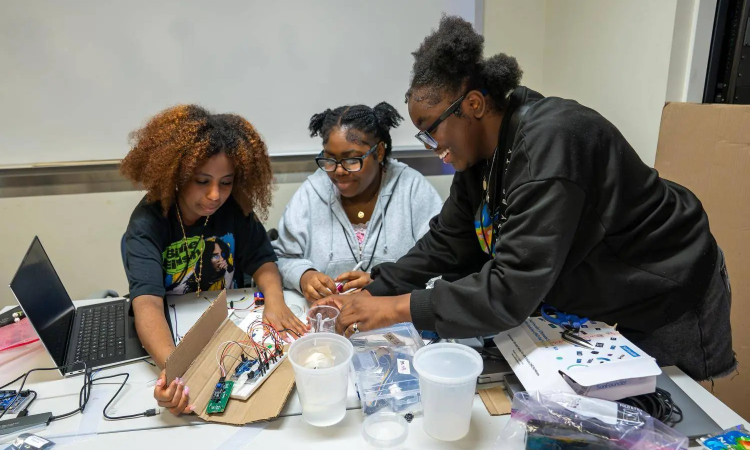
Future AI Engineers Get Hands-On at Georgia Tech’s CoSense Summer Institute
Co-led by the CoCoSys and CogniSense research centers, the CoSense Summer Institute introduced Georgia high school students to advanced sensor and AI technologies.