
Backed by $10.6 million from DARPA, Georgia Tech researchers are investigating how nanoscale mechanical forces can help computers process information using less energy.
(text and background only visible when logged in)

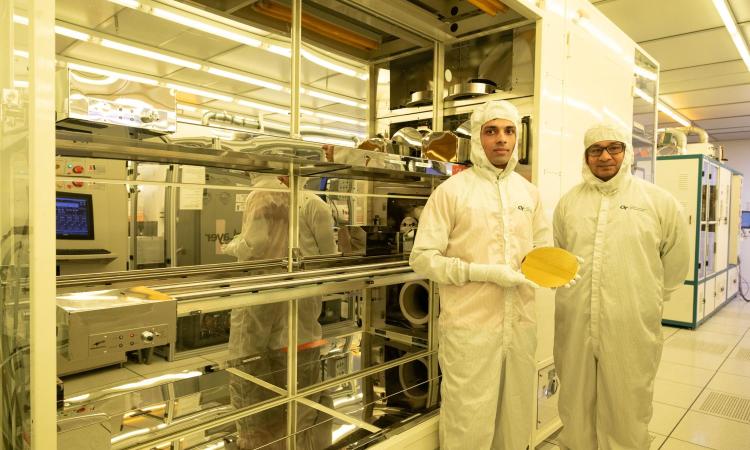
Applying mechanical strain to semiconductor devices can improve the flow of electrons, enabling faster and more energy-efficient computing. Image above is not a depiction of an actual device or experimental result.
Every computer, from the large, clunky machines of the past to today's AI accelerators, depends on a physical phenomenon that can represent information. For decades, that role has been played by the controlled movement of electrical charge through billions of transistors etched onto a chip.
A Georgia Tech-led research team is exploring a different approach. Rather than relying on charge alone to perform logic operations, the researchers are investigating whether nanoscale mechanical strain can serve as a new way to represent and process information.
"Whether it's charge, light, magnetism, or strain, computing doesn't care how information is transported as long as it reliably represents a one and a zero," said School of Electrical and Computer Engineering Associate Professor Asif Khan. "Our approach explores a different path by blending multiple information-carrying modalities together."
Led by Khan, the effort has received $10.6 million from the Defense Advanced Research Projects Agency's (DARPA) Fast and Curious program, an initiative focused on developing logic circuits that are at least 100 times more energy efficient than today's state-of-the-art technologies.
Computing Through Strain
The project, known as Mechanically Amplified Ferroic-Actuated (MEFA) Logic, uses ferroic materials that slightly expand or contract when voltage is applied. That motion is amplified and directed into a nearby semiconductor channel, where it changes how current flows and enables the device to switch between logic states.
In simple terms, the team is investigating whether tiny mechanical forces can become part of the way computers process information.
"A new computing technology only becomes useful if it can ultimately fit into the broader semiconductor ecosystem," Khan said. "We're thinking about manufacturability and integration from the beginning."
Building Beyond CMOS
DARPA launched Fast and Curious to explore beyond-CMOS computing technologies. CMOS, short for complementary metal-oxide-semiconductor, is the transistor technology that powers virtually every modern computer chip, smartphone, and electronic device.
(text and background only visible when logged in)

A leader in ferroelectric materials research, Khan is exploring how mechanical strain can be used to tune the behavior of these advanced materials. The work could help enable a new generation of faster, more energy-efficient computing technologies.
The program challenges researchers to develop new devices, materials, and architectures that could operate far more efficiently than conventional CMOS while remaining compatible with advanced semiconductor manufacturing.
The Georgia Tech-led team includes collaborators from Rice University, the University of Southern California, and Northrop Grumman's Space Park Foundry.
Low Power, High Potential
As the project advances from individual devices to increasingly sophisticated circuits, the team's ultimate objective is to demonstrate a computing technology capable of operating with dramatically lower energy requirements while remaining practical for real-world applications.
"The exciting part isn't just the device physics," Khan said. "It's the possibility of combining extremely low energy consumption with the speed and functionality required for real computing systems."
That combination is what the team hopes will distinguish MEFA from other beyond-CMOS approaches.
(text and background only visible when logged in)
Related Content

Georgia Tech and Samsung Look to Unleash the Future of Digital Storage
The collaboration hopes to redefine digital storage, tackling the core of AI progress by reducing voltage in NAND flash technology through a new ferroelectric structure.
(text and background only visible when logged in)
Smaller, Smarter, Speedier, Stacked
Some technologists suggest we’re nearing the limits of packing ever-more computing power into ever-smaller chips. At Georgia Tech, engineers are finding new ways to shrink transistors, make systems more efficient, and design better computers to power technologies not yet imagined.
(text and background only visible when logged in)