
Professor Emeritus Russell Dupuis became the first ECE faculty member to headline the series, offering a career’s worth of perspective on semiconductor innovation and its real-world impact.

Professor Russell D. Dupuis presents a Carreker Distinguished Lecture, reflecting on the development of metalorganic chemical vapor deposition and its role in advancing modern technologies.
(text and background only visible when logged in)
Professor Russell D. Dupuis reflected on more than five decades of semiconductor innovation during the second Carreker Distinguished Lecture, held March 31, 2026, in the Klaus 1116 Conference Room.
His talk, “The Development of Metalorganic Chemical Vapor Deposition for Traveling on the Alloy Road,” traced the scientific, technological, and commercial journey of compound semiconductors and the role Georgia Tech has played along the way.
Dupuis, professor emeritus in the School of Electrical and Computer Engineering and the School of Materials Science and Engineering, is a Steve W. Chaddick Endowed Chair in Electro‑Optics and a Georgia Research Alliance Eminent Scholar. In January 2025, he was awarded the Japan Prize, one of the world’s most prestigious honors in science and technology, for work that laid the foundation for LEDs, lasers, solar cells, and other technologies now embedded in everyday life.
(text and background only visible when logged in)

Following his lecture, Dupuis answers questions from the audience on semiconductor innovation and the future of compound materials.

From left: Professor Bruno Frazier, Dupuis, Professor and Steve W. Chaddick School Chair Arijit Raychowdhury, and John Slaughter Chair in Semiconductor Alan Doolittle.
Using the metaphor of an “alloy road,” Dupuis framed semiconductor progress as a long journey defined by materials engineering and steady innovation. Rather than being driven by individual elements, the field advanced through carefully designed semiconductor alloys that expanded what devices could do.
That trajectory converged in metalorganic chemical vapor deposition (MOCVD), the epitaxial growth technique Dupuis helped pioneer. MOCVD is used to make the ultra‑thin, precisely engineered semiconductor layers behind light‑emitting diodes (LEDs), laser diodes, high‑efficiency solar cells, and many of the optoelectronic technologies that power modern communications and computing.
Dupuis’s work on MOCVD proved especially transformative for LEDs. The technique helped turn LEDs from expensive laboratory devices into efficient, reliable, and affordable sources of light. As production scaled, solid‑state lighting reshaped displays, smartphones, architectural lighting, and energy use worldwide.
The lecture also placed these advances within the broader history of electronics. According to Dupuis, the invention of the transistor marked the point at which semiconductors shifted from scientific curiosities into industrial drivers, setting in motion decades of progress in materials growth and device design.
Dupuis was the first faculty member to deliver a Carreker Distinguished Lecture, marking an important expansion of the ECE lecture series. Alongside industry leaders, the series looks to provide a platform for ECE faculty to share the stories, long‑term impact, and real‑world reach of their work.
The inaugural Carreker Distinguished Lecture, held in November, featured Mark Papermaster, chief technology officer and executive vice president of Advanced Micro Devices (AMD).
(text and background only visible when logged in)
Related Content
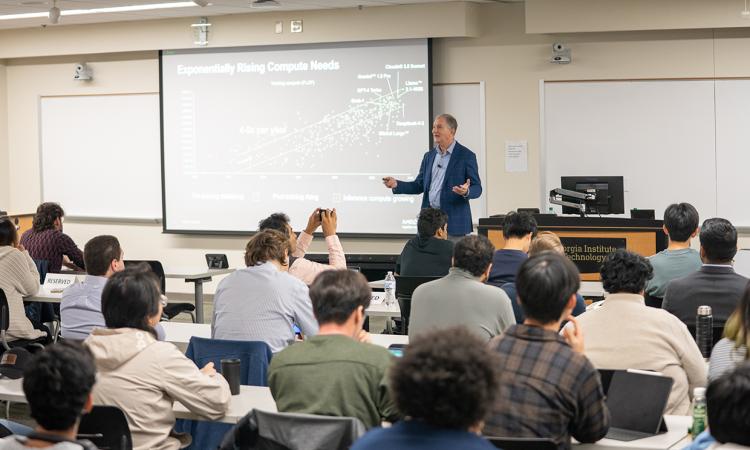
AMD CTO Mark Papermaster Headlines ECE Distinguished Lecture
One of industry’s top AI and computing experts delivered ECE’s inaugural Carreker Distinguished Lecture, emphasizing that success in the AI era depends on collaboration, integration, and holistic design.
(text and background only visible when logged in)

Open configuration options Carreker Professorship Established with Davenport Named Inaugural Recipient
The new endowed role reflects the Carrekers’ commitment to advancing ECE’s mission and recognizes Davenport’s leadership in research and education.
(text and background only visible when logged in)