
The professor was honored for his contributions to and leadership in high-performance and energy-efficient logic transistor research.

(text and background only visible when logged in)
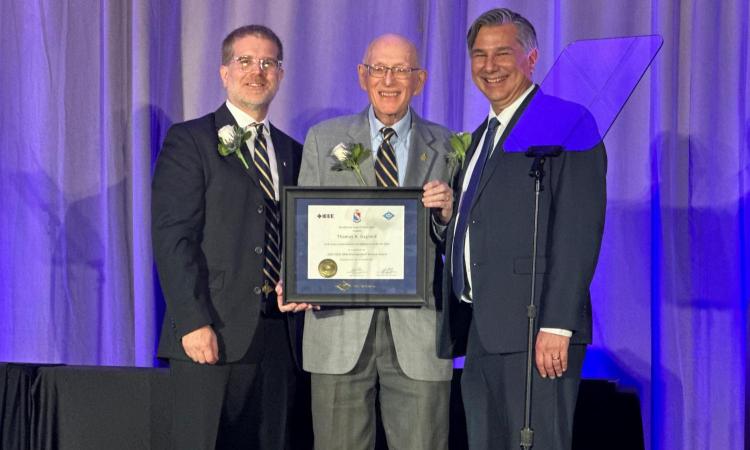
Georgia Tech School of Electrical and Computer Engineering Professor Suman Datta won the 2026 IEEE Andrew S. Grove Award.
The award is given annually to an individual or a team of up to three people for outstanding contributions to solid-state devices and technology. It’s named after former Intel CEO Andrew Grove, a legend of Silicon Valley.
Datta received the honor for his contributions to and leadership in high-performance and energy-efficient logic transistor research.
His pioneering work in metal-oxide-semiconductor transistors has had far-reaching effects on the semiconductor landscape.
His seminal contributions to high-k/metal gate transistors, FinFETs, and non-silicon channel complementary metal-oxide-semiconductor (CMOS) transistors remain impactful for modern microprocessor technology and have helped shape the semiconductor industry.
His work bypassed previous physical limitations, enabling levels of transistor performance and energy efficiency once thought unattainable. Datta has steered influential multi-university research initiatives that continue to define the semiconductor industry’s transistor roadmap.
The advances in mobile, high-performance, and accelerated computing over the last two decades were made possible in part due to Datta’s work in commercial logic transistor technologies.
Datta’s current work focuses on the exploration of emerging semiconductor devices and their integration into novel computing architectures to address the physical limits of traditional CMOS scaling.
His work is deeply rooted in system-technology co-optimization, specifically leveraging charge-based memories and monolithic 3D integration to overcome the "memory wall" in AI and high-performance computing. He is investigating the use of non-volatile ferroelectric transistors and amorphous oxide semiconductor transistors for advanced memory, logic, and power delivery applications.
Datta has spent his career in transistor research.
From 1999 to 2007, he was in the Advanced Transistor Group at Intel Corporation, where he led device research and development efforts for several generations of high-performance logic transistors, such as high-k/metal gate, Tri-gate, and strained channel CMOS transistors.
He then went to hold professorships at the University of Notre Dame and The Pennsylvania State University, where his group at the latter pioneered advances in compound semiconductor-based quantum-well field effect transistors and tunneling field effect transistors.
He has published over 500 journal and refereed conference papers and holds more than 187 issued patents related to semiconductor devices. In 2013, Datta was named a Fellow of the IEEE and a Fellow of the National Academy of Inventors in 2016.
He will accept the award at the 72nd Annual IEEE International Electron Devices Meeting in San Francisco at the end of 2026.
Related Content

Raheem Beyah, Gabriel Rincón-Mora Named AAAS Fellows
The ECE researchers are recognized for their lifetime achievements in cybersecurity and microchip technology.
Gaylord Wins IEEE-HKN Distinguished Service Award
Honored for decades of service, the Regents Professor has been instrumental in supporting Beta Mu, Georgia Tech’s Eta Kappa Nu chapter, widely regarded as one of the strongest in the country.