
The Semiconductor Research Corporation has honored the ECE chair with the Aristotle Award for his long-standing commitment to student mentorship and engineering education, making him only the second Georgia Tech faculty member to earn the distinction.
(text and background only visible when logged in)

Georgia Tech School of Electrical and Computer Engineering Steve W. Chaddick School Chair Arijit Raychowdhury has received the Semiconductor Research Corporation’s (SRC) Aristotle Award.
First presented in 1995, it recognizes faculty whose “deep commitment to the educational experience of students has had a profound and continuing impact on their professional performance and, consequently, a significant impact for members over a long period of time.”
Raychowdhury is just the second Georgia Tech faculty member to receive the honor, joining ECE Professor Emeritus Jim Meindl, who won it in 2004.
“Any credit here really belongs to the students,” Raychowdhury said. “Their curiosity, resilience, and willingness to dive into hard, unfamiliar problems are what make this kind of recognition possible in the first place. Watching them grow into researchers and engineers in their own right has been the most rewarding part of my career by far.”
Raychowdhury, who joined the ECE faculty in 2013 and became chair in 2021, leads one of the nation's largest and highest-ranked electrical and computer engineering programs. Under his leadership, the School has continued to expand its impact in education, research, and workforce development.
His teaching spans foundational and advanced topics in integrated circuits, VLSI design, and embedded systems, combining theory and hands-on applications to prepare students for research and industry careers.
Raychowdhury's own research sits at the frontier of energy-efficient and resilient computing, with contributions spanning energy-efficient integrated circuit design, power management for electronic systems, AI hardware accelerators, and emerging directions such as cryogenic and embodied AI silicon.
“Arijit taught me to look beyond solving a problem and ask why it matters, while giving me the freedom and support to grow as an independent researcher” said Zishen Wan, assistant professor at Columbia University, who earned his Ph.D. at Georgia Tech under Raychowdhury's supervision. “As I begin my own faculty career, his example continues to shape how I hope to mentor my students: with high expectations, patience, and a deep commitment to their growth.”
As the Steve W. Chaddick School Chair, Raychowdhury has advanced new models for industry engagement in engineering education. This includes ECE’s Curriculum Partnership Initiative, which brings industry expertise directly into the curriculum through collaborative course development, industry-led instruction, and project-based learning opportunities.

Raychowdhury received the Semiconductor Research Corporation's Aristotle Award, which honors faculty whose dedication to students has shaped generations of engineering leaders.
Additionally, he serves as director of the Center for the Co-Design of Cognitive Systems (CoCoSys), one of six centers within the Joint University Microelectronics Program 2.0 (JUMP 2.0), an SRC-led public-private partnership with DARPA that supports hundreds of students across multiple universities.
Raychowdhury holds more than 27 U.S. and international patents and has published over 250 articles in journals and refereed conferences. He is currently a Distinguished Lecturer of the IEEE Solid-State Circuits Society (SSCS) and the site director for the DoD-sponsored SCALE Workforce development program in SoC Design.
He and his students have won 18 best paper awards over the years, on top numerous more honors, including being named a Fellow of the IEEE and the National Academy of Innovators and winning the SRC Technical Excellence Award in 2021.
(text and background only visible when logged in)
Related Content
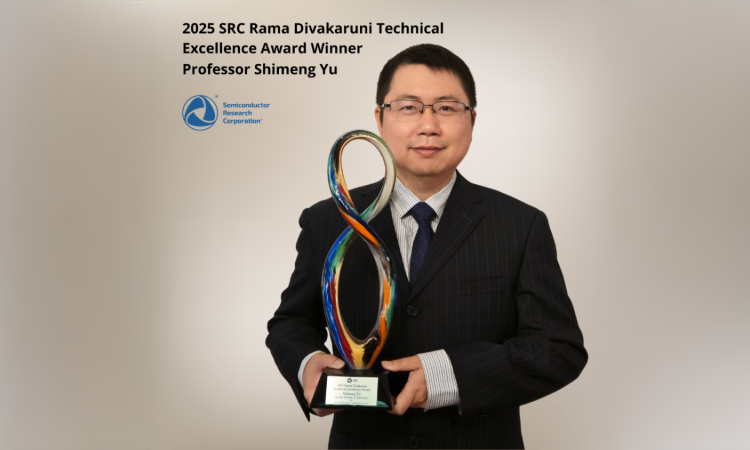
Yu Receives SRC Technical Excellence Award
The ECE professor was honored for advancing open-source tools and memory technologies shaping future computing.
(text and background only visible when logged in)
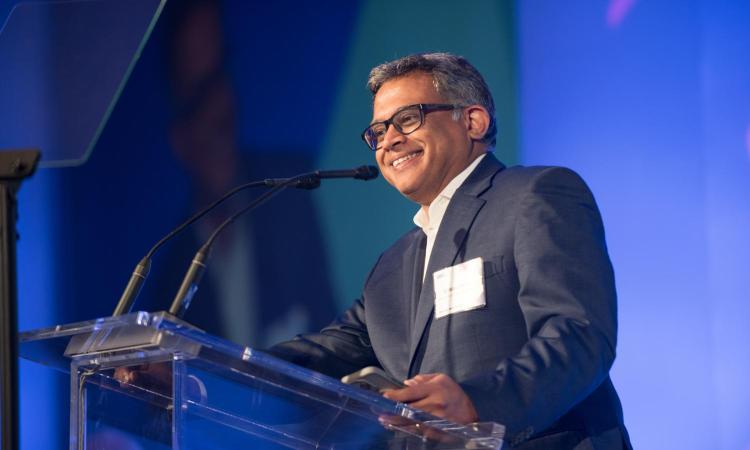
Datta Receives University Research Award for Excellence in Semiconductor Research
Given by the Semiconductor Research Corporation and Semiconductor Industry Association, the award recognizes lifetime research contributions to the U.S. semiconductor industry.
(text and background only visible when logged in)