
Researchers in the Tri-Institutional Center for Translational Research in Neuroimaging and Data Science are developing an artificial intelligence approach for analyzing functional magnetic resonance imaging to identify subtle brain-network patterns associated with Alzheimer's risk in seemingly healthy patients.

Long before memory loss or confusion appears, Alzheimer's disease may already be causing changes in the brain. These biological changes can go undetected for years, making early identification one of the field's biggest challenges and opportunities.
Georgia Tech researchers are developing an artificial intelligence (AI) approach to identify subtle brain-network patterns associated with Alzheimer's risk in people who have not yet developed symptoms.
The study, published in IEEE Transactions on Biomedical Engineering, introduces a new AI framework that analyzes and learns from noninvasive functional magnetic resonance imaging (fMRI) scans of symptomatic brains to identify these subtle patterns in pre-symptomatic brain scans.

The AI model uses fMRI scans of brains diagnosed with Alzheimer's Disease to identify patterns of the disease in seemingly healthy-looking brains.
“Standard methods implicitly assume the brain features of symptomatic and pre-symptomatic patients are directly comparable, when they actually aren’t,” lead researcher Yuxiang Wei said. “The progressive neurodegenerative nature of the disease causes significant anatomical and functional differences between stages.”
Wei, a Ph.D. student in the Georgia Tech School of Electrical and Computer Engineering (ECE), developed the approach alongside Professor Vince Calhoun, a Georgia Research Alliance Eminent Scholar, with faculty appointments at Georgia Tech, Georgia State University, and Emory University. Calhoun also directs the Tri-Institutional Center for Translational Research in Neuroimaging and Data Science (TReNDS), a partnership among the three universities.
How it Works
Over 55 million people worldwide live with dementia, and Alzheimer’s disease is the number one cause, accounting for up to 70 percent of cases. Currently, no cure exists for the debilitating disease, with memory loss, issues with problem-solving, and difficulty processing visual images and spatial relations among the most common symptoms.
Patients typically live just four to eight years after a diagnosis.
“The field is increasingly moving toward biomarker-informed, biology-based descriptions of Alzheimer’s disease, but reliably identifying subtle presymptomatic patterns using noninvasive brain imaging remains challenging,” Calhoun said.
One promising source of those patterns is fMRI, a noninvasive brain scanning technique that measures changes in blood flow to reveal how different regions of the brain communicate.
To help identify presymptomatic patterns, the team engineered a multi-stage AI framework driven by Unbalanced Optimal Transport (UOT), a mathematical technique designed to find meaningful relationships between data that may not appear directly comparable — in this case, the brain-network patterns in scans associated with advanced Alzheimer's to patterns seen in the disease's earliest stages.

Yuxiang Wei

Vince Calhoun
The UOT framework is applied in a Teacher-Student model. The "teacher" AI learns the "fingerprints" on clear cases of advanced Alzheimer's and passes its knowledge to a "student" AI that specializes in recognizing much subtler signs of disease. The student model is designed to utilize dynamic decision margins, which are especially sensitive to rare, early indicators that might otherwise be overlooked among the many scans of healthy individuals.
Unlike traditional AI models that try to directly compare patients at different stages of Alzheimer's, the UOT framework is designed to identify patterns that persist as the disease progresses.
Crucially, the “unbalanced” nature of this mathematics allows the AI to learn which changes in brain networks are shared across stages and which are simply normal variations between individuals.

A "teacher" AI trained on clear cases of advanced Alzheimer's passes its knowledge to a "student" AI that specializes in recognizing much subtler signs of disease.
Potential Impact on Research and Treatment
More accurate identification of presymptomatic Alzheimer's disease could help researchers intervene earlier and improve the development of new therapies.
“Identifying presymptomatic participants is one of the biggest bottlenecks in that process,” Wei said. “If validated in larger and more diverse populations, the approach could help researchers identify potential participants for prevention-focused Alzheimer's clinical trials.”
While the findings demonstrate a promising proof of concept, Calhoun cautioned that the framework is not yet a clinical diagnostic tool.
The next step is to evaluate the method using larger and more diverse datasets and determine how much information it adds beyond established biomarkers and clinical assessments. The researchers are also exploring how to incorporate additional imaging and biological data to improve performance and support future Alzheimer's research and clinical trials.
This material is supported by the National Science Foundation under Grant No. 2112455, and the National Institutes of Health grant #1R01AG90597 and R01EB006841. The funders had no role in study design, data collection and analysis, decision to publish, or preparation of the manuscript.
(text and background only visible when logged in)
Related Content

Researchers Identify Crucial Biomarker That Tracks Recovery from Treatment-Resistant Depression
Harnessing the power of explainable AI, researchers have unveiled the first insights into the complex workings of deep brain stimulation therapy for severe depression.
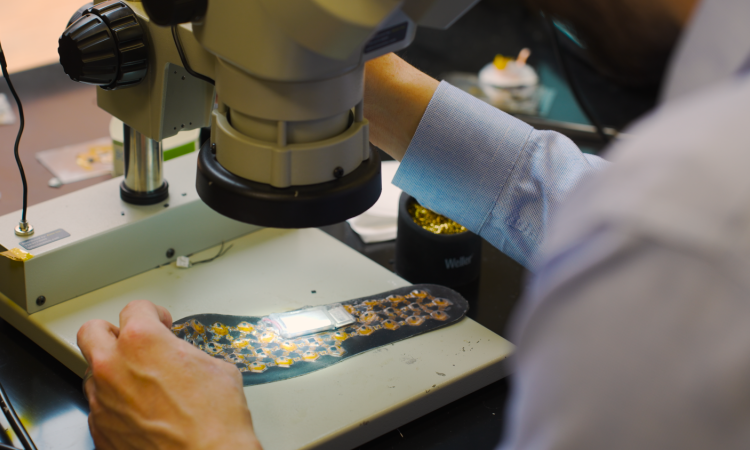
New Wearable Reroutes Lost Sensation, Restores Stability
Researchers have developed a wireless wearable that translates foot pressure into heat and vibration, helping individuals with sensory impairments regain balance and mobility.