
The ACM SIGARCH Maurice Wilkes Award recognizes the professor's contributions to architectures and modeling tools for large-scale AI systems.

(text and background only visible when logged in)
Tushar Krishna has received the 2026 ACM SIGARCH Maurice Wilkes Award, one of computer architecture's highest honors for mid-career researchers.
Presented by the Association for Computing Machinery’s (ACM) Special Interest Group on Computer Architecture (SIGARCH), the award recognizes one practitioner every year whose work has had a significant impact on the field of computer architecture within the last 20 years.
The Maurice Wilkes Award is named for British computer scientist Maurice Wilkes, who is widely considered as the father of microprogramming and shaped the development of modern computing systems.
Krishna, an associate professor in the School of Electrical and Computer Engineering (ECE) with a courtesy appointment in the School of Computer Science (SCS), was specifically recognized “for outstanding contributions to architectures and modeling tools for large-scale AI systems.” The award was presented at the 53rd International Symposium on Computer Architecture (ISCA), which was held in Raleigh, N.C. this summer.
“Joining the ranks of several pioneers of my field of computer architecture who won this award in the past is truly an honor and feels extremely humbling,” Krishna said. “The recognition is as much mine as it is of my students, innumerable collaborators, and technical mentors alongside whom I learned about the fascinating field of AI systems and jointly developed new tools and architectures.”
The honor reflects more than a decade of Krishna’s research that has helped shape the computing infrastructure behind modern artificial intelligence (AI).
“Tushar's selection for the Maurice Wilkes Award is a remarkable achievement and a well-deserved recognition,” said Arijit Raychowdhury, Steve W. Chaddick School Chair of ECE. “Having worked closely with him for the past decade, I can attest that he brings a rare combination of foundational discovery and applied engineering, consistently pushing the boundaries of computing research. Just as importantly, he has built a strong community of students and collaborators whose contributions continue to advance the field.”
As AI evolved from convolutional neural networks to transformers and large language models, spanning training and inference, Krishna's work has focused on developing the architectures, hardware-software abstractions, and open-source tools needed to design and evaluate increasingly complex AI systems. His team’s research has provided a foundation for designing and optimizing AI systems across the algorithm, software, and hardware stack.
Among Krishna's contributions are ASTRA-sim and Chakra, open-source frameworks developed by him and his team with close collaboration with industry partners.
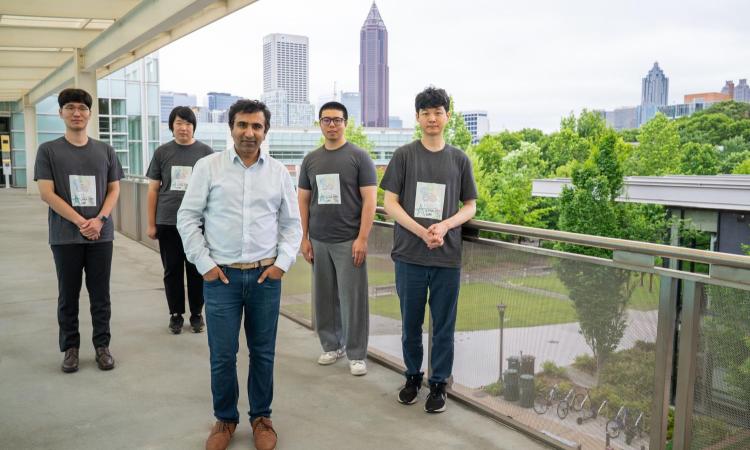
A Common Language to Understand AI Systems
Read how Krishna and collaborators developed Chakra to create a common language for understanding AI systems.
These tools enable researchers and industry engineers to model, benchmark, and optimize large-scale AI platforms that that span thousands of specialized processors distributed across warehouse-scale data centers, providing insights into how future AI infrastructure can be designed for greater performance and efficiency.
“Georgia Tech has a long tradition of leadership in computer architecture, and Tushar represents the next generation carrying that tradition forward,” said Hyesoon Kim, chair of SCS. “Through open-source tools, community tutorials, and strong collaborations, Tushar has enabled researchers to simulate and evaluate AI infrastructure at scale, helping the broader community design the computing systems for the next generation of AI.”
The impact of Krishna's work is reflected in nearly 190 publications, more than 23,000 citations, an h-index of 53, and Hall of Fame recognitions from all three premier computer architecture conferences. Through more than 15 tutorials, he has also helped educate thousands of researchers and students worldwide.
“This recognition reinforces my belief that the future of AI will require much closer collaboration across the entire computing stack, from hardware to networking to software systems to AI algorithms,” Krishna said. “I see this award not as the culmination of a journey, but as the beginning of a new chapter. As AI moves toward increasingly autonomous, agentic systems, we're being challenged to rethink the very foundations of computing. I'm excited to work with my students and collaborators to help define that future.”
Krishna is the first Georgia Tech ECE faculty member to receive the award in its 28-year history. SCS Professor Moinuddin Qureshi was recognized with the award in 2022.
(text and background only visible when logged in)
Related Content
Krishna Wins Under-40 Innovator's Award for AI Computing Design Tools
The Design Automation Conference recognized Tushar Krishna for work on an ecosystem of AI design tools to help enable the future of computing.
Smaller, Smarter, Speedier, Stacked
Some technologists suggest we’re nearing the limits of packing ever-more computing power into ever-smaller chips. At Georgia Tech, engineers are finding new ways to shrink transistors, make systems more efficient, and design better computers to power technologies not yet imagined.