
Professor Karthikeyan Sundaresan is leading a $4.8 million NSF project aimed at turning groups of drones into a self-adapting wireless system that can move, communicate, sense, and reconfigure itself in real time.
(text and background only visible when logged in)

Georgia Tech's OMNISCIENT project is developing an adaptive wireless system that will allow groups of drones to stay connected and share information as they move across large areas. Graphics and video thanks to Roberto Chamorro Martinez, graduate research assistant, MARGA Lab.
Drones can already provide a valuable view of disaster areas, search difficult terrain, and reach places where sending people may be difficult or dangerous. The next challenge is enabling multiple drones to work together as a swarm, covering larger areas while staying connected throughout complex missions.
Karthikeyan Sundaresan is tackling that challenge through Project OMNISCIENT, a three-year effort supported by a $4.8 million award through the National Science Foundation’s Verticals-enabling Intelligent Network Systems (VINES) program.
The project will develop an intelligent wireless network that can adapt as drones move, gather information, and take on different roles.
“The goal is to move beyond thinking about one pilot and one drone,” Sundaresan, a professor in the School of Electrical and Computer Engineering, said. “We want the focus to be on the mission while the drones and the network figure out how to work together.”
Building a Network in the Air
Each drone will carry a wireless communications payload that allows it to become part of an aerial network. Rather than every drone needing its own direct connection back to the ground, information can travel from one drone to another across the swarm, extending the network as the drones move. The researchers are building on open 5G technology to create what Sundaresan describes as a dynamic, reconfigurable aerial mesh network that could help shape next-generation 6G systems.
That would allow drones farther from the ground station to remain connected while sending back information. Some drones may be gathering 4K video or thermal imagery, while others help carry those streams across the network. The goal is to maintain the high bandwidth and low latency needed to bring information from multiple drones back to the ground in real time.
“The ultimate vision is for the entire drone operation to work together as part of the mission,” Sundaresan said. “Eventually, drones could take on interchangeable roles, gathering information at one point and helping maintain the network at another, depending on the needs of the mission.”
A Digital Twin for the Swarm
The project will pair that wireless network with an AI-powered digital twin that helps orchestrate how it operates. The digital twin will maintain a real-time model of the drones and their connections, allowing it to determine where drones should move, which should communicate with one another, and how wireless resources should be allocated as the mission changes.
The digital twin can also run different scenarios as conditions change, allowing it to weigh trade-offs before the person overseeing the mission decides what to do next. If drones need to move farther into a search area, for example, the system could automatically reconfigure the network around that decision while maintaining the connections needed to keep information flowing.

“As the drones move, the network has to move with them,” Sundaresan said. “The digital twin is what allows us to understand those changes and reconfigure the network in real time. It will allow a pilot to focus on what matters — the mission-critical decisions, while the management of the swarm itself is offloaded to the digital twin.”
Building Toward Real-World Use
OMNISCIENT is designed with translation in mind, bringing together university researchers, the Georgia Tech Research Institute (GTRI), and industry collaborators.
GTRI will help build wireless payloads that enable the adaptive network and integrate them onto the drones. The researchers plan to begin with two drones, increase to five, and ultimately demonstrate the system with seven.
Flock Safety, a public safety technology company that builds automated surveillance hardware and software for law enforcement, will serve as the project’s application partner, bringing its experience with drone-as-first-responder operations. The University of Washington will contribute to digital-twin research, including its expertise in simulation.
OMNISCIENT also represents an early research win for Georgia Tech’s Center for Wireless Intelligence (CWI), which was established in 2025 to bring together academic, GTRI, and industry expertise around next-generation wireless technology.
HOW IT WORKS
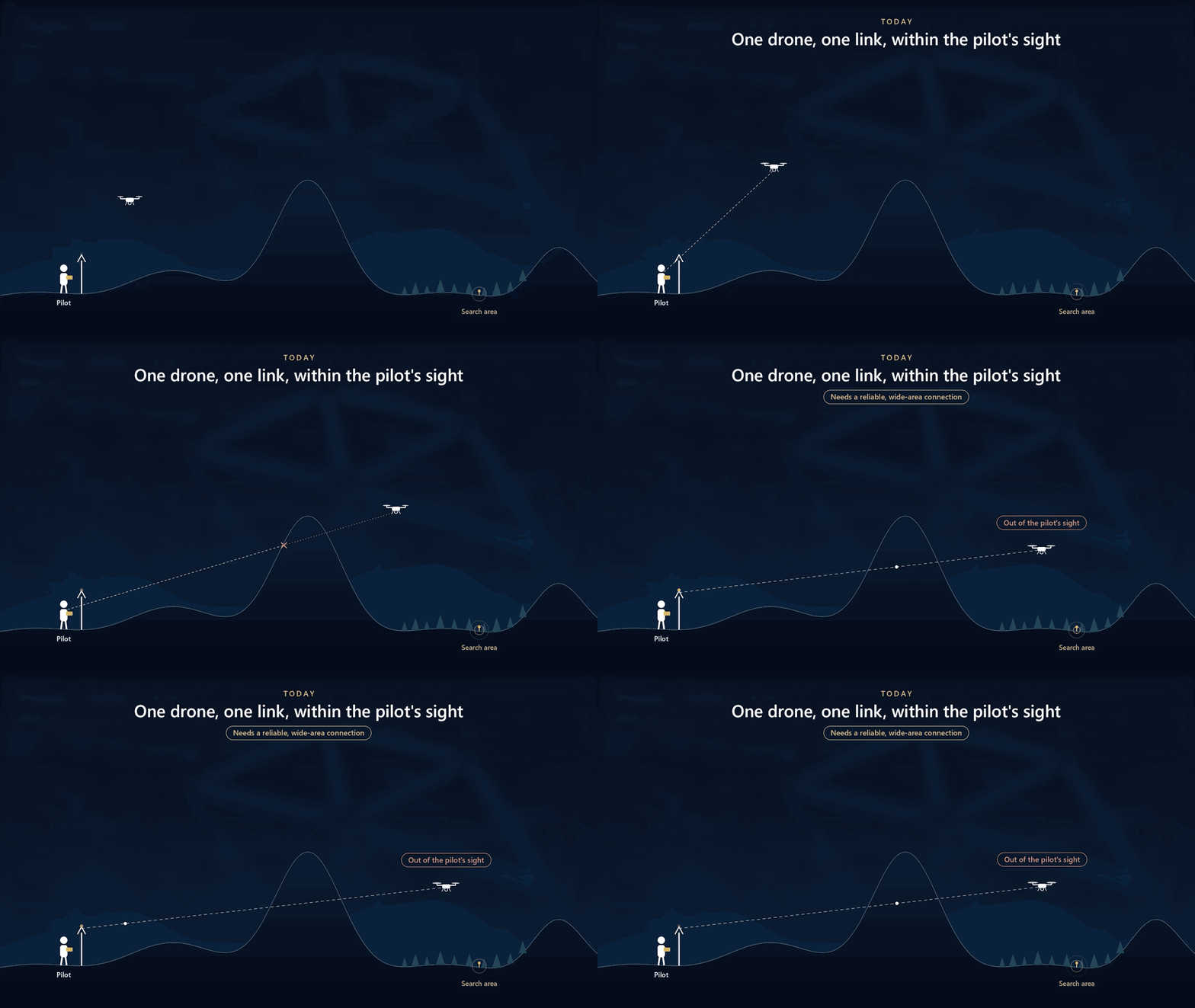
Currently, most drones are operated one at a time by one pilot and connections can weaken or be lost because of distance, terrain, buildings, or other obstacles.
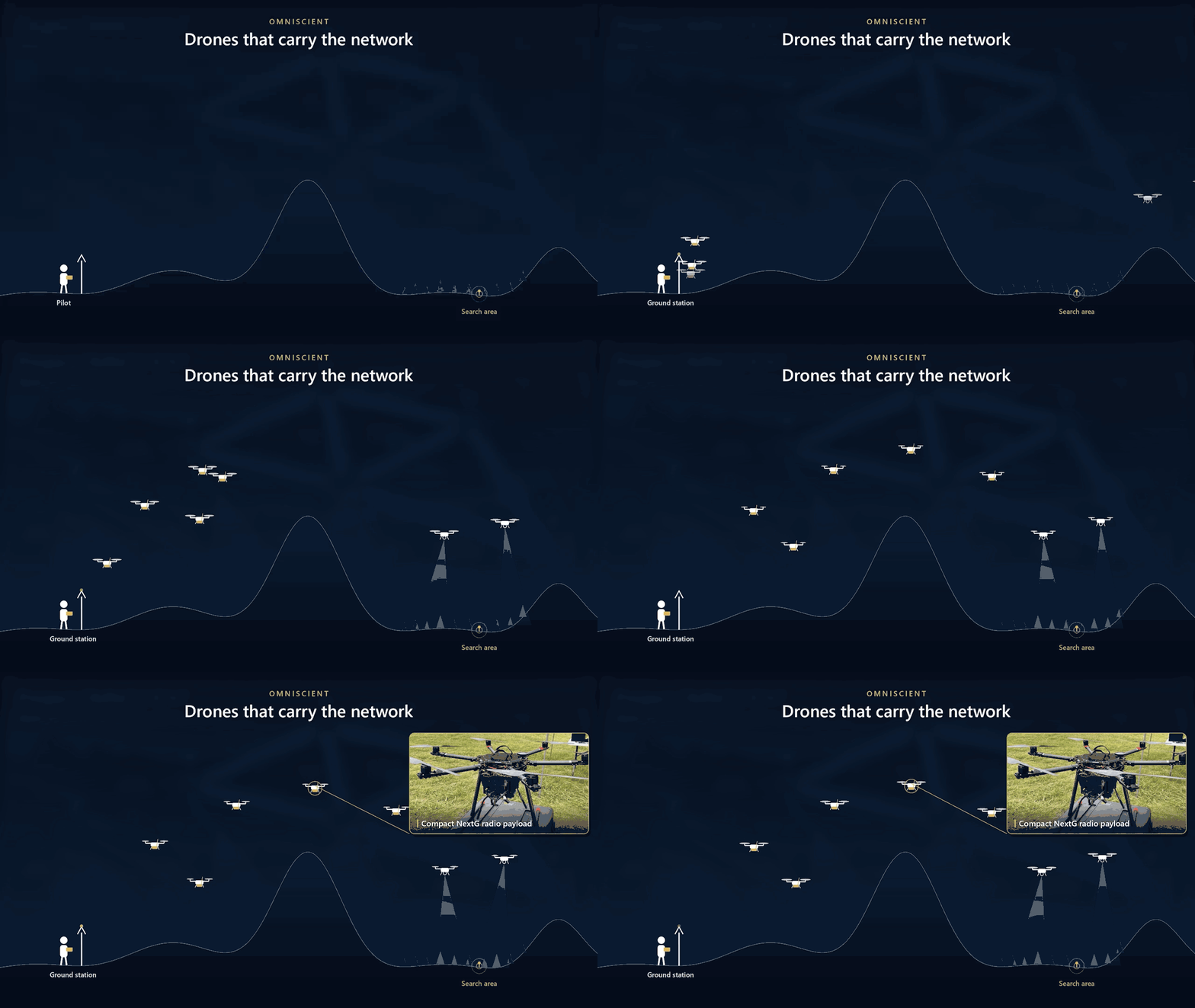
The OMNISCIENT project will allow a single operator to deploy a swarm across a hazardous or hard-to-reach area, allowing multiple drones to cover more ground at once.
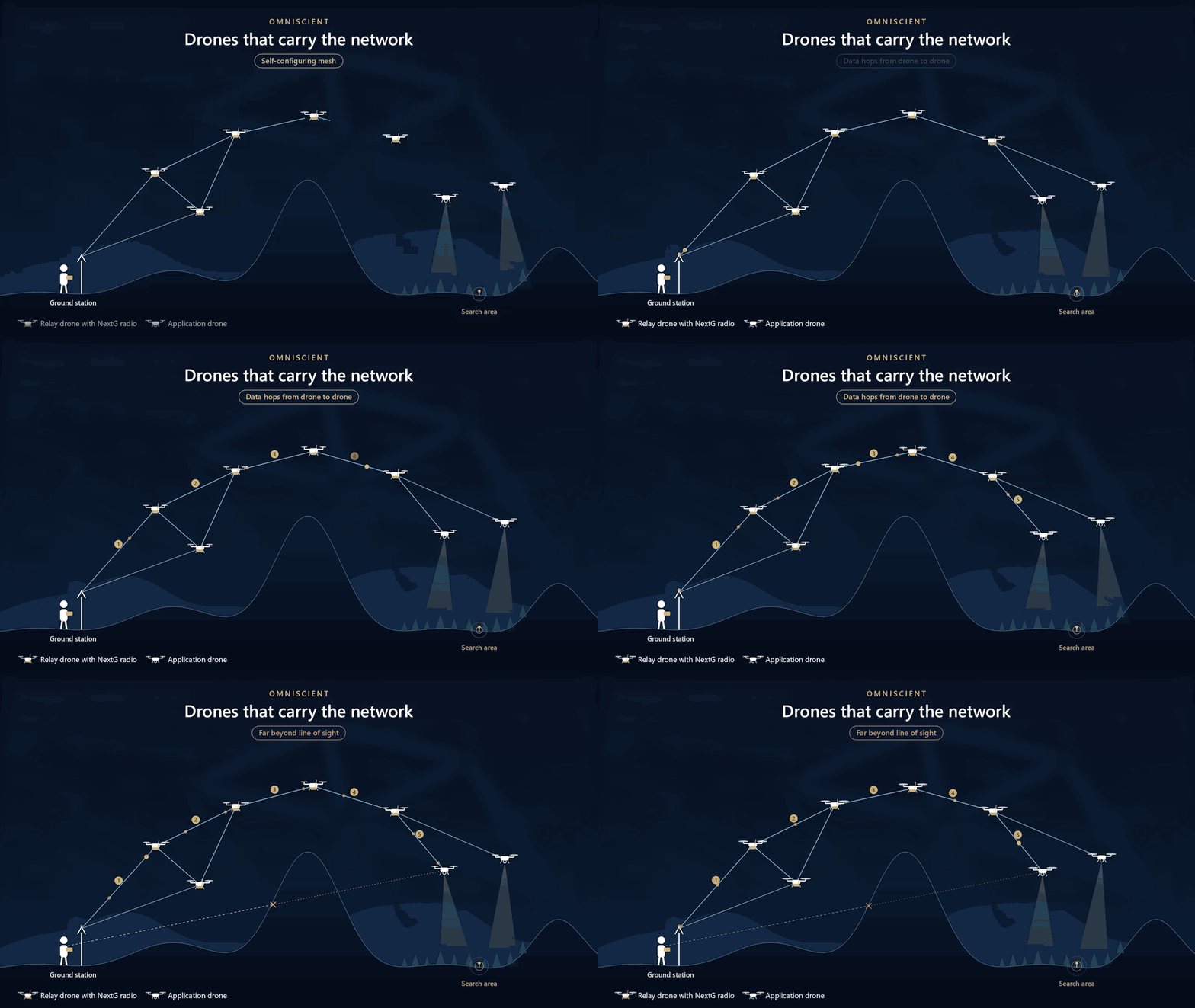
As the swarm spreads out, drones can relay information through one another, extending the network beyond the range of a single connection.

A digital twin keeps a real-time picture of the swarm, using information about the drones and their connections to help the network adapt as conditions change.
Taking Drone Networks Further
Although the project’s physical demonstrations will involve up to seven drones, the digital twin will allow the researchers to explore how the approach could work at a much larger scale.
“The digital twin will give us a framework to test and scale for hundreds of drones,” Sundaresan said. “As wireless payloads become smaller and more energy efficient, they could eventually be carried by smaller drones and support much larger swarms.”
In addition to Project OMNISCIENT, Sundaresan is also involved in a second VINES project, SEA-NET, a $5 million effort focused on maritime search and rescue and oil-spill monitoring led by Spectronn Inc. His role focuses on autonomous control and connectivity of drones launched from maritime vessels, coupled with network-aware AI that can encode video semantically so the information most relevant to the mission can still be transmitted when bandwidth is limited.
Though separate efforts, both projects reflect Sundaresan’s broader focus on expanding what connected drones can do across large, challenging environments, and complex missions.
“Eventually, the technology should fade into the background,” Sundaresan said. “People should be making the mission-critical decisions while the drones and the network handle the complexity underneath.”
(text and background only visible when logged in)
Related Content
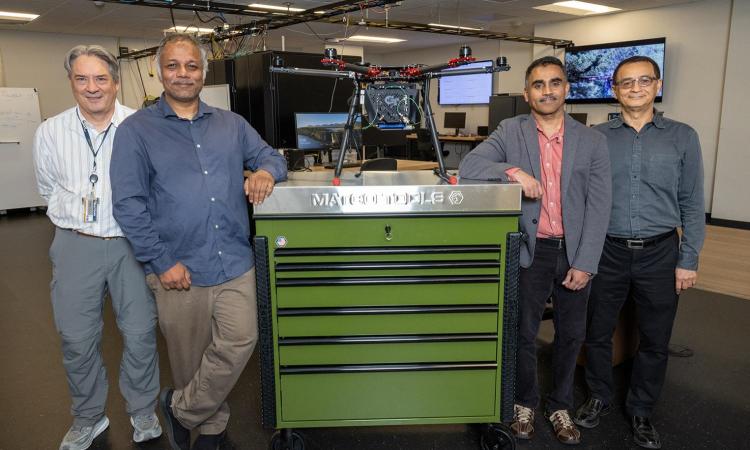
Momentum Builds for FutureG Wireless Communications with Launch of New Research Center
The Center for Wireless Intelligence establishes Georgia Tech as a hub for wireless innovation, powered by a top-tier testbed spanning multiple sites and deep cross-sector collaboration.
(text and background only visible when logged in)

How a Lens Is Pushing the Limits of Near-Zero‑Power Wireless Communication to Gigabits‑Per‑Second Speeds
Emmanouil Tentzeris and Marvin Joshi’s new work demonstrates how a lens‑enabled backscatter system can deliver modern wireless capability without traditional transmitters.
(text and background only visible when logged in)